Study in Germany: Guide for International Students
This guide explains how to study in Germany as an international student in 2026. It covers the German university system, tuition-free public universities, English-taught programmes, the real cost of one year (with a data chart), scholarships, the student visa with the €11,904 blocked account, and your work rights during and after your degree. Use the tabs to jump to any section.
Why Study in Germany?
Germany offers a combination no other major study destination matches in 2026: public universities with no tuition fees for international students, globally recognised degrees, and an 18-month post-study visa to find a job in Europe’s largest economy.
Germany has more than 400 state-recognised higher education institutions teaching over 20,000 degree programmes. Around half a million international students are already enrolled, which makes Germany the most popular study destination in the world where English is not the native language.
What is Germany best known for academically?
Engineering, computer science, natural sciences, and medicine carry the strongest reputation. Behind the universities stands a research network few countries can match: the Max Planck Society for fundamental research, Fraunhofer for applied engineering, and the Helmholtz and Leibniz institutes. Universities such as TU Munich, LMU Munich, and Heidelberg regularly rank in the world’s top 100.
A quick example
Compare two students starting a Master’s in computer science in 2026. One pays roughly $60,000 in tuition over two years in the United States. The other pays €0 in tuition at a public German university and spends around €12,000–€15,000 per year on living costs. Both graduate with an internationally respected degree — one of them with far less debt.
How the German University System Works
Germany has three types of institutions, and choosing the right type matters as much as choosing the right university.
| Type | Focus | Best for | Awards PhDs? |
|---|---|---|---|
| Universität (research university) | Theory and research | Sciences, humanities, medicine, law, future PhD plans | Yes |
| Fachhochschule / HAW (applied sciences) | Practical teaching with industry projects | Career-focused engineering, business, IT | Rarely (usually via a partner university) |
| Kunst-/Musikhochschule (art and music academy) | Artistic training | Fine arts, design, music, film | Selected fields |
How do German degrees work?
Germany follows the European Bologna system: a Bachelor’s (3–4 years, 180–240 ECTS credits), a Master’s (usually 2 years, 120 ECTS), and a doctorate (3–5 years). Medicine, law, and pharmacy still use a longer Staatsexamen (state examination) route instead of the Bachelor–Master split.
When do semesters start?
The winter semester begins in October and is the main intake; the common application deadline is 15 July. The summer semester begins in April with a smaller programme selection; the common deadline is 15 January. Many universities set earlier dates, so always confirm on the programme page.
What You Can Study: Degree Levels
Germany has an entry route at every stage of an academic career.
- Bachelor’s degrees — mostly taught in German; whether you can enter directly depends on how your school certificate is recognised. Read the full Bachelor guide.
- Master’s degrees — the strongest option for international students, with the largest English-taught catalogue in continental Europe. Read the full Master’s guide.
- PhDs — in Germany a doctorate is often a salaried research job, not a fee-paying course. Browse live PhD, postdoc, and faculty openings on the UpperCareers jobs board, or find a matching professor with the UpperCareers Supervisor Finder. Read the full PhD guide.
- Pathway options — the Studienkolleg foundation year, exchange semesters, and German language courses for applicants who do not yet qualify directly.
Language of Instruction: English or German?
Can I study fully in English in Germany?
Yes — but mainly at Master’s level. Well over 2,000 Master’s programmes are taught entirely in English. English-taught Bachelor’s programmes exist but number only in the hundreds, and many are at fee-charging private universities.
Do I need to learn German?
Not for an English-taught degree. In practice, everyday German (level A2–B1) makes part-time jobs, housing, and paperwork much easier — and employers strongly prefer B2 or better when you look for a job after graduation.
Which language tests are accepted?
| Study language | Accepted tests | Typical requirement |
|---|---|---|
| English-taught | IELTS Academic, TOEFL iBT | IELTS 6.0–6.5 / TOEFL 80–90 |
| German-taught | TestDaF, DSH, Goethe C2, telc C1 Hochschule | TestDaF 4×4 or DSH-2 |
Cost of Studying in Germany (2026 Figures)
Is tuition really free?
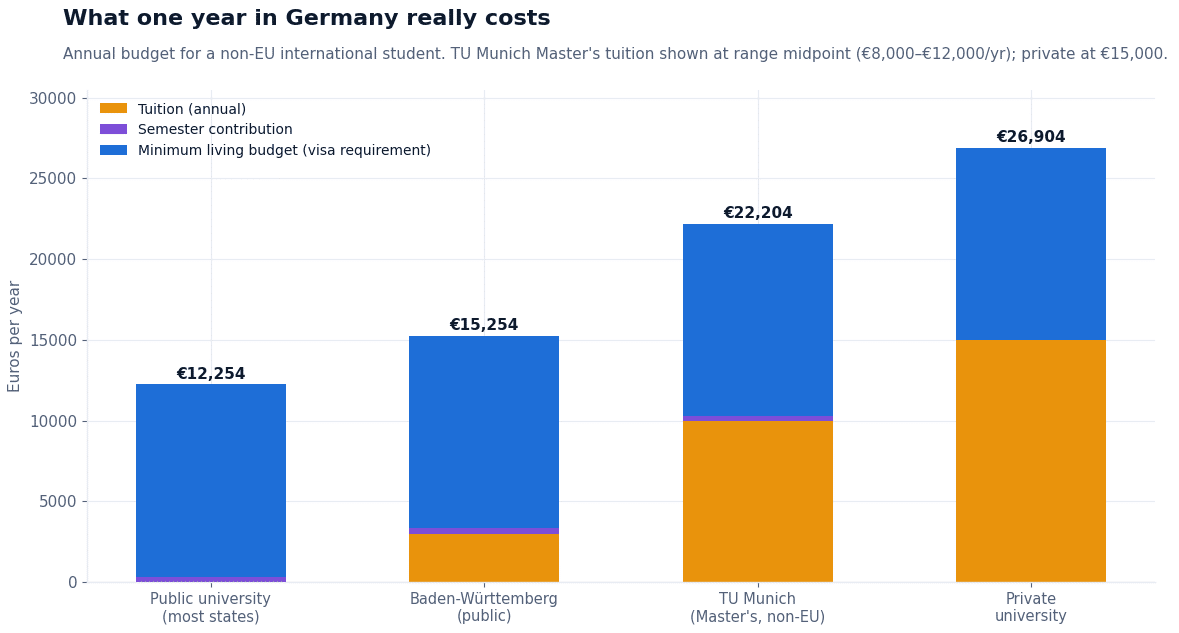
At public universities, yes — with two exceptions. Baden-Württemberg charges non-EU students €1,500 per semester, and TU Munich (Bavaria) introduced tuition for non-EU students from winter 2024/25: roughly €4,000–€6,000 per year for Bachelor’s and €8,000–€12,000 per year for Master’s programmes. Everywhere else, you pay only a semester contribution of about €100–€400, which usually includes a regional transport ticket.
What total budget should I plan?
A realistic first year at a public university costs €12,000–€17,000 including living costs and health insurance (about €125 per month for students under 30). Munich, Frankfurt, and Hamburg sit at the top of that range; Leipzig, Dresden, and smaller university towns at the bottom.
The blocked account (Sperrkonto)
For the visa you must prove funds for one year. In 2026 the required amount is €11,904, deposited in a blocked account and released to you at €992 per month after arrival. The figure is adjusted regularly, so check the current amount when you apply.
Scholarships and Funding
Because tuition is free, German scholarships fund living costs — and most students combine savings with part-time work rather than relying on a scholarship.
- DAAD — the German Academic Exchange Service, the world’s largest funder of international students; strongest at Master’s (EPOS programmes) and PhD level.
- Deutschlandstipendium — €300 per month, merit-based, open to all nationalities, applied for through your university.
- Erasmus+ and Erasmus Mundus — funding for EU-linked exchanges and fully funded joint Master’s degrees.
- Political and religious foundations — Konrad-Adenauer, Friedrich-Ebert, Heinrich-Böll and others fund international students with strong academic and social profiles.
Example: a student who wins the Deutschlandstipendium and works a part-time job at Germany’s 2026 minimum wage of €13.90 per hour for 15 hours a week covers most of a mid-range monthly budget without touching savings.
The German Student Visa
Which visa do I need?
Non-EU students need a national visa for study purposes (type D), which is converted into a student residence permit after arrival. EU and EEA citizens need no visa at all.
What must I show at the appointment?
- University admission letter (or conditional admission)
- Proof of funds — a blocked account with €11,904, a formal sponsor declaration, or a recognised scholarship
- Health insurance, academic certificates, and language proof
- APS certificate if you apply from India, China, or Vietnam
How long does the visa take?
Plan for 6–12 weeks at most German missions; high-volume countries can take longer. Book your appointment the day you receive admission — or earlier where the mission allows advance booking.
Working During and After Your Studies
How many hours can students work?
International students may work 140 full days or 280 half days per year without extra permission. Student jobs pay at least the 2026 minimum wage of €13.90 per hour; working-student roles in your own field often pay €15–€20.
Can I stay in Germany after graduation?
Yes. Graduates of German universities receive an 18-month residence permit to look for a job, with full work rights during the search. Once you sign a qualified contract, you switch to a work permit or an EU Blue Card — the direct path toward permanent residency, which Blue Card holders can reach in as little as about two years with German language skills.
Which fields hire international graduates?
Germany’s official shortage occupations — software development, mechanical and electrical engineering, healthcare, and skilled technical roles — actively recruit from university graduates. German at level B2 remains the single biggest advantage in the job market.
Official Websites Every Applicant Should Bookmark
These are the government and publicly funded websites behind almost every fact in this guide. Use them to verify anything before you act.
| Website | Run by | What you will find there |
|---|---|---|
| DAAD — daad.de | German Academic Exchange Service (publicly funded) | The central portal for international students: a scholarship database you can filter by country and degree level, an admission-requirements database for your school certificate, and country-specific application advice. |
| Study in Germany — study-in-germany.de | Federal Foreign Office + DAAD | The official “Study in Germany” campaign site: plain-language overviews of degree types, costs, visas, and student life, plus a programme search — a good first stop before diving into university pages. |
| Hochschulkompass | German Rectors’ Conference (HRK) | The official database of every accredited German degree programme and doctoral opportunity. If a programme is not listed here, question its accreditation. |
| anabin | Standing Conference of the Ministers of Education (KMK) | The official recognition database. Look up your school certificate or degree to see whether it qualifies you for direct admission, a Studienkolleg, or case-by-case review. |
| German missions abroad | Federal Foreign Office | Your local embassy or consulate page lists the exact visa documents, the current blocked-account amount, appointment booking, and processing times for your country — the only binding source for visa rules. |
| Make it in Germany | Federal Government skilled-worker portal | Everything about staying after graduation: the 18-month job-seeker permit, EU Blue Card rules, recognition of qualifications, and job listings run with the Federal Employment Agency. |
All sites above are run by German federal bodies, the state ministers’ conference (KMK), or publicly funded organisations. Information there overrides anything you read elsewhere, including this guide.
Frequently Asked Questions
Is education in Germany really free for international students?
Can I study in Germany without knowing German?
How much money do I need for a German student visa in 2026?
Can I work in Germany while studying?
How long can I stay in Germany after graduating?
Which intake is better, winter or summer?
Accuracy note: fees, deadlines, and visa rules change. The figures in this article were verified in July 2026 (blocked account €11,904 / €992 per month, uni-assist €75 + €30, Baden-Württemberg €1,500 per semester, APS India ₹18,000). Always confirm the current rules on the official university, DAAD, or German-mission page before you act. Nothing here is a guarantee of admission, funding, or a visa.