Master’s in Germany: Fees, Eligibility & Application
This guide explains how to get a Master’s in Germany as an international student in 2026. It covers eligibility and grade conversion, English-taught programmes, applying through uni-assist, a step-by-step timeline, tuition compared across university types (with a data chart), scholarships such as DAAD EPOS, and the 18-month post-study work visa.
About Master’s Studies in Germany
How long is a Master’s degree?
Most German Master’s programmes run 2 years (4 semesters, 120 ECTS credits) and end with a Master thesis. One-year and 18-month formats exist, mainly at private universities.
Consecutive vs non-consecutive programmes
A consecutive Master’s continues your Bachelor subject directly — and is tuition-free at most public universities. A non-consecutive or executive Master’s (an MBA, for example) targets professionals and career-changers and may charge fees even at public institutions. Check which type your programme is before assuming it is free.
Course-based vs research-based
Most programmes are course-based with a thesis semester at the end. Research-oriented Master’s programmes, common in the sciences, integrate lab work throughout — they are the natural springboard into a German PhD.
Finding the Right Programme
How do I choose the right Master’s programme?
Work backwards from the admission page. German universities admit by subject fit: they compare your Bachelor’s module list (ECTS credits in specific areas) against their entry requirements. A brilliant GPA in the wrong module mix loses to a decent GPA in the right one.
Which universities are best for my field?
Engineering and computer science: the TU9 alliance (TU Munich, RWTH Aachen, TU Berlin and peers). Natural sciences: LMU Munich, Heidelberg, Göttingen. Business: Mannheim and Cologne among public universities, WHU and Frankfurt School among private ones. Applied, industry-facing degrees: the large universities of applied sciences.
Are there English-taught Master’s programmes?
More than 2,000 — the largest English-taught catalogue in continental Europe, spanning nearly every discipline from data science to public policy.
Eligibility and Grade Conversion
Is my Bachelor’s degree recognised in Germany?
If your university and degree appear with positive status in the anabin database, you are generally eligible. Applicants from India, China, and Vietnam additionally need an APS certificate verifying their documents before the visa stage.
Do I need a 3-year or 4-year Bachelor’s?
Three-year degrees (180 ECTS) are accepted for most 120-ECTS Master’s programmes. A minority of programmes require 240 ECTS; a 4-year degree or extra coursework closes that gap.
What GPA do I need — with a worked example
Competitive public programmes typically expect the equivalent of a German grade of 2.5 or better. Universities convert your grade using the “modified Bavarian formula”. Example: an Indian student with 75% where 40% is the pass mark converts to 1 + 3 × (100 − 75) / (100 − 40) = German 2.25 — comfortably inside the typical cut-off. Run your own numbers before ruling yourself out.
Do I need GRE, GMAT, or work experience?
Usually not. A minority of technical programmes ask for the GRE; GMAT and work experience matter mainly for MBAs and management degrees.
How to Apply: Portals, Documents, Timeline
Where do I apply — uni-assist or direct?
About half of German universities route international applications through uni-assist (€75 for the first programme choice in a semester, €30 for each additional one; evaluation takes about 4–6 weeks). The rest use their own portals. The programme’s admission page always states which route applies.
What documents do I need?
- Bachelor’s degree certificate and full transcript, with certified translations
- Statement of Purpose tailored to the specific programme
- CV in Europass or standard academic format
- 1–2 letters of recommendation, where required
- Language certificate — IELTS/TOEFL or TestDaF/DSH
- APS certificate (India, China, Vietnam)
What are the deadlines and intakes?
| Intake | Semester starts | Common deadline | Programme choice |
|---|---|---|---|
| Winter | October | 15 July — many programmes close 31 May or earlier | Full catalogue; main intake |
| Summer | April | 15 January | Limited selection |
What steps should I follow?
- Shortlist 6–10 programmes — about 12 months out.Match your Bachelor modules against each programme’s ECTS requirements in the screener.
- Book your language test.IELTS/TOEFL for English-taught, TestDaF/DSH for German-taught; results take weeks.
- Start APS if you apply from India, China, or Vietnam.Begin at least 3 months before your first deadline.
- Submit applications via uni-assist or university portals.Upload certified translations, SOP, CV, and certificates; pay per programme choice.
- Accept an offer and open the blocked account.Deposit €11,904 for the year and take out student health insurance.
- Apply for the type-D student visa.Book the appointment immediately; processing takes 6–12 weeks.
- Arrive and enrol.Enrol, register your address, and collect your residence permit.
Studying in English or German
Can I do my entire Master’s in English?
Yes — comfortably. English-taught programmes are abundant in engineering, computer science, data science, economics, and the life sciences, and most of them are tuition-free at public universities.
What scores do I need?
Typically IELTS 6.5 (some programmes accept 6.0) or TOEFL iBT around 88–90. German-taught programmes require TestDaF 4×4 or DSH-2.
Do I need German for daily life and jobs?
You can survive without it — but you cannot thrive. Reaching B1–B2 during your two study years is the single best investment in your post-graduation salary and job search.
Tuition, Budget and Scholarships
What are the tuition fees in 2026?
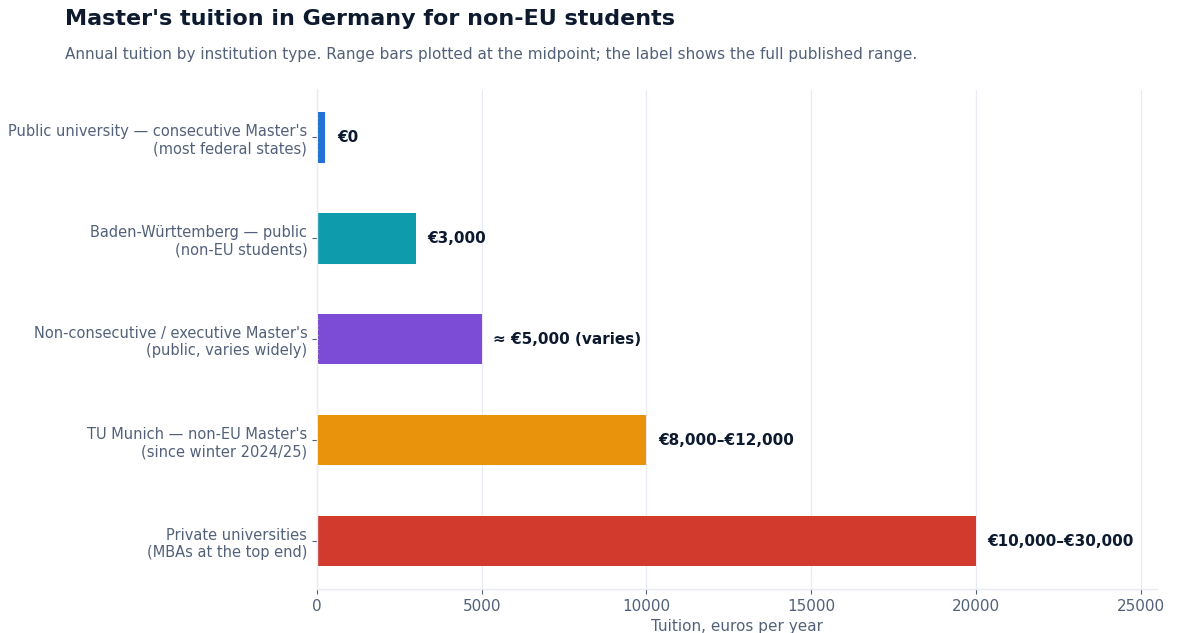
Range bars are plotted at the midpoint; labels show the full published range. TU Munich’s fees apply to students enrolling from winter semester 2024/25 onward.
What budget should I plan?
€950–€1,300 per month covers most cities; Munich and Frankfurt run higher. For the visa you must show €11,904 in a blocked account (2026 figure), released at €992 per month after arrival.
Which scholarships fund Master’s students?
- DAAD EPOS — full scholarships for development-related Master’s programmes, aimed at professionals from developing countries
- Deutschlandstipendium — €300 per month, merit-based, via your university
- Erasmus Mundus — fully funded joint Master’s degrees with a German partner university
- Foundation scholarships — Konrad-Adenauer, Friedrich-Ebert, Heinrich-Böll and peers
Can I work part-time during my Master’s?
Yes — 140 full days or 280 half days per year. Master’s students often land Werkstudent (working-student) roles in their own field at €15–€20 per hour; these routinely turn into full-time offers at graduation.
Career After Your Master’s
What are my post-study options?
German-degree holders receive an 18-month job-seeker permit with full work rights. A qualified job offer converts it into an EU Blue Card — and Blue Card holders can reach permanent residency in roughly two years with German language skills.
What salary can I expect?
Master’s graduates in engineering and IT typically start at €48,000–€60,000 gross per year; business and science graduates slightly below. Salaries are highest in the south (Bavaria, Baden-Württemberg) — as are living costs.
Thinking about a PhD instead?
A German Master’s is the standard gateway into Germany’s salaried doctorate system — see the PhD in Germany guide. You can already browse live PhD openings on the UpperCareers jobs board and identify potential supervisors with the UpperCareers Supervisor Finder.
Official Websites for Master’s Applicants
Bookmark these before you shortlist a single programme — they are the primary sources this guide is built on.
| Website | Run by | What you will find there |
|---|---|---|
| DAAD scholarship database | German Academic Exchange Service | Filter scholarships by your country, subject, and degree level. The EPOS development-related Master’s scholarships and their deadlines live here. |
| Hochschulkompass | German Rectors’ Conference (HRK) | The official list of all accredited Master’s programmes, searchable by subject, language of instruction, and university type. |
| uni-assist | Official application service of German universities | Submit applications, check whether your programme uses the standard or VPD procedure, and see current handling fees and processing times. |
| Study in Germany — study-in-germany.de | Federal Foreign Office + DAAD | Official guidance on choosing a programme, financing your degree, and preparing your visa file — written specifically for international applicants. |
| Make it in Germany | Federal Government skilled-worker portal | The authoritative pages for what happens after your Master’s: job-seeker permit rules, current EU Blue Card conditions, and how employers verify foreign degrees. |
| German missions abroad | Federal Foreign Office | Country-specific visa checklists, the current blocked-account requirement, and appointment booking for your student visa. |
All sites above are run by German federal bodies, the state ministers’ conference (KMK), or publicly funded organisations. Information there overrides anything you read elsewhere, including this guide.
Frequently Asked Questions
Is a Master’s in Germany free for international students?
Do I need IELTS for a Master’s in Germany?
Is a 3-year Bachelor’s degree accepted for a German Master’s?
How much does uni-assist cost in 2026?
Do I need GRE or work experience for a German Master’s?
Can I stay in Germany after finishing my Master’s?
Accuracy note: fees, deadlines, and visa rules change. The figures in this article were verified in July 2026 (blocked account €11,904 / €992 per month, uni-assist €75 + €30, Baden-Württemberg €1,500 per semester, APS India ₹18,000). Always confirm the current rules on the official university, DAAD, or German-mission page before you act. Nothing here is a guarantee of admission, funding, or a visa.