PhD in Germany: Application, Funding, Salary & Visa
This guide explains how to apply for a PhD in Germany in 2026. It covers the two doctoral routes (individual and structured), how to find a supervisor or an advertised position, what German PhDs pay under the TV-L E13 scale (with a data chart), DAAD funding, the researcher visa, family rights, and a 12-month application timeline.
How German PhDs Work
Is a PhD a job or a study programme in Germany?
Frequently a job. Most doctoral researchers in the sciences hold an employment contract with their university or institute, earn a public-sector salary with pension and social insurance, and pay no tuition — a fundamental difference from the US or UK model.
Individual vs structured doctorate
| Individual doctorate | Structured programme | |
|---|---|---|
| Share of German PhDs | Roughly three in four | Roughly one in four |
| How it works | You find a supervisor (Doktorvater / Doktormutter) and research independently | Cohort-based graduate school with coursework and milestones |
| Typical funding | Employment contract or scholarship | Programme-funded position or stipend |
| How to enter | Direct contact with a professor, or an advertised position | Formal application rounds with fixed deadlines |
How long does a PhD take?
Officially three years; realistically 3.5–5 depending on the field, with the natural sciences at the shorter end and the humanities at the longer.
Finding a Position or Supervisor
How do I find open PhD positions?
- Advertised positions — universities and research institutes post salaried PhD openings like job vacancies. Browse live postdoctoral, faculty, and PhD positions from universities worldwide on the UpperCareers jobs board.
- Graduate schools — DFG Research Training Groups, Max Planck Schools, and international doctoral programmes with annual calls.
- Direct approach — identify professors publishing in your niche and write to them.
Should I contact professors directly?
For the individual doctorate — yes, it is the standard route. Finding the right professors to write to is the hard part: the UpperCareers Supervisor Finder searches 347,467 active researchers worldwide by research topic, university, or country, with every match scored and explained — no guesswork about who actually works on your field. Then send a short, specific email: who you are, which of their papers your idea builds on, a one-page research sketch, and your CV. Example of what works: “Your 2025 paper on X left open question Y; my Master’s thesis developed method Z, which could address it.” Generic mass emails are deleted; specific ones get replies.
Which institutions are strongest in my field?
Look beyond universities. Max Planck (fundamental research), Fraunhofer (applied engineering), Helmholtz (large-scale science), and Leibniz institutes all employ doctoral researchers — often on better funding terms than university chairs.
Eligibility for a German Doctorate
Do I need a Master’s degree?
Almost always yes — a recognised Master’s (or an equivalent German Diplom/Magister) in a relevant field is the standard entry requirement. Direct bachelor-to-PhD fast tracks exist but are rare and highly selective.
What grades and experience do supervisors expect?
Typically a Master’s grade equivalent to German 2.0 or better, plus evidence you can actually do research: a strong thesis, lab experience, or ideally a publication or conference paper.
Do I need the GRE or a research proposal?
GRE: virtually never. A research proposal: essential for the individual doctorate and for scholarship applications. For advertised positions the project is pre-defined, and a strong motivation letter replaces the proposal.
Application Procedure and 12-Month Timeline
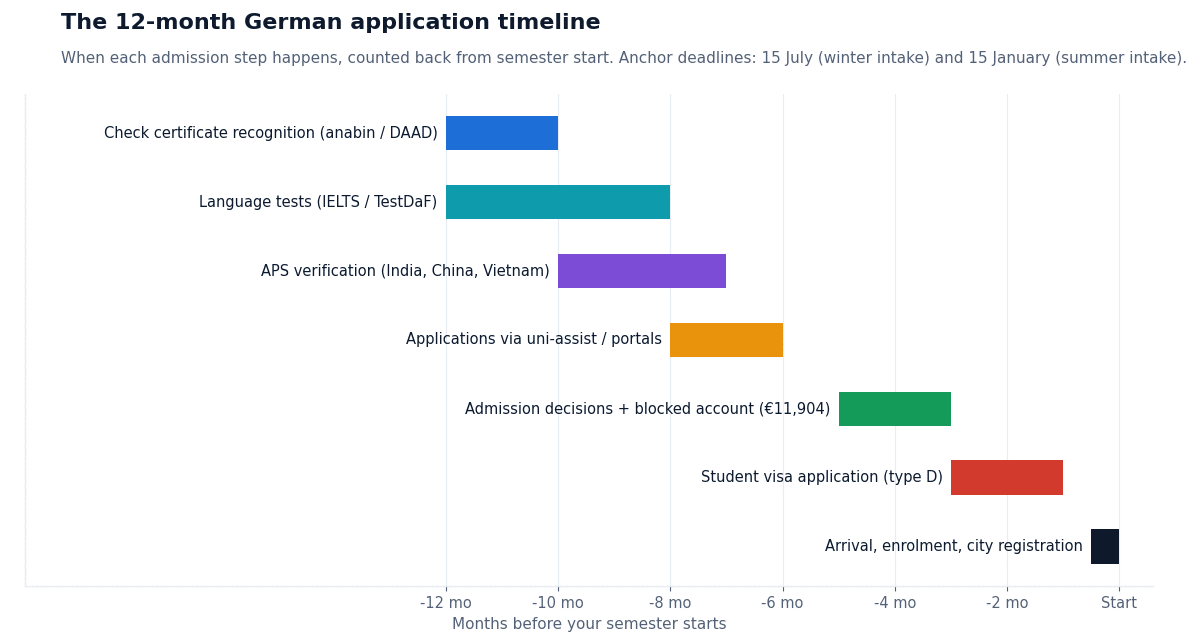
- Months 12–10: define your niche.Draft a one-to-two-page research sketch; list 10–15 professors or programmes whose work it extends.
- Months 10–8: contact supervisors or apply to openings.Personalised emails for the individual route; formal applications for advertised positions on the job board.
- Months 8–6: interviews and funding decision.Video interviews on your proposal and methods; clarify whether funding is a contract, a scholarship, or still pending.
- Months 6–4: formal admission.The faculty’s doctoral committee verifies your Master’s (APS certificate required for India, China, Vietnam) and registers you as a doctoral candidate.
- Months 4–2: visa application.Apply for the researcher or student visa with your contract or supervision confirmation; allow 6–12 weeks.
- Month 0: relocate and register.Sign your contract, register your address, enrol where required — and start researching.
What makes a strong research proposal?
Two pages that show three things: a precise, answerable question; why this group is the right place to answer it; and a realistic method and timeline. German supervisors value focus over ambition — narrow and rigorous beats broad and vague.
Language Requirements for PhDs
Can I do my PhD entirely in English?
Yes — in the natural sciences, engineering, and economics, English is the working language of most research groups, and theses may usually be written in English. The humanities and law more often expect German.
Do I need German for teaching or daily life?
Some university contracts include teaching duties that may require German; research-institute positions rarely do. For daily life and any later career in Germany, plan to reach B1 during the doctorate — many universities offer free German courses to doctoral staff.
Funding and Salary: What a German PhD Pays
Are PhD positions paid — and how much?
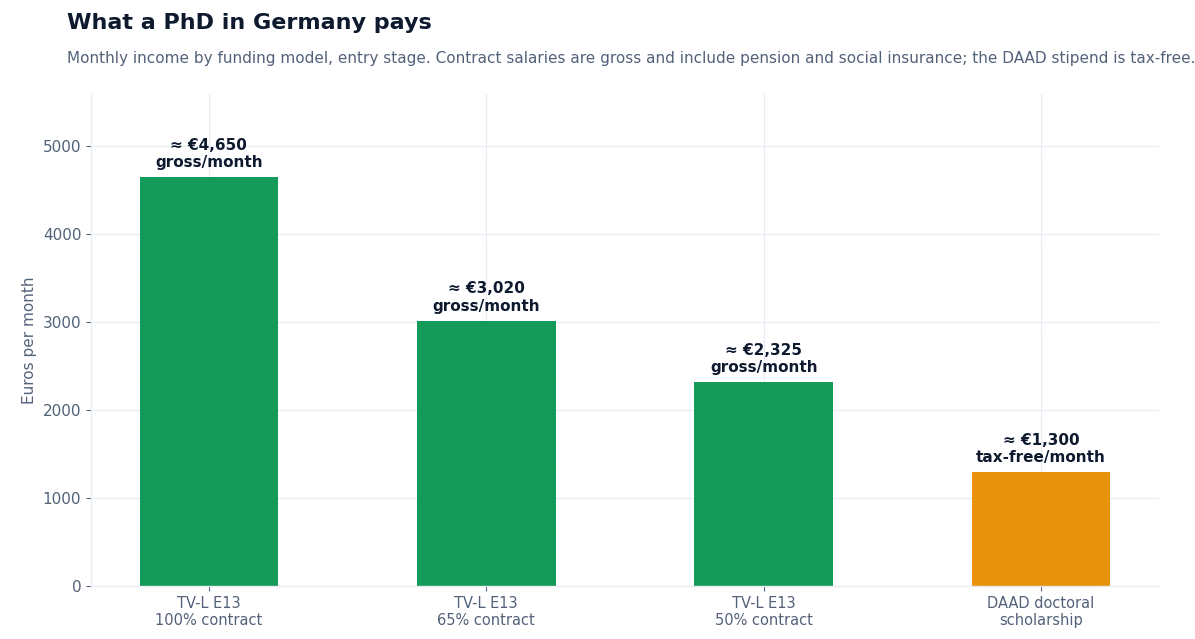
Salaried positions follow the public TV-L E13 pay scale. Most science PhDs are hired at 50–75% of a full-time E13 post, which works out to roughly €2,300–€3,500 gross per month at entry stage, with pension and social insurance included. Salaries rise with experience stages during the doctorate.
Which scholarships fund international PhD candidates?
DAAD doctoral scholarships (around €1,300 per month, tax-free, plus insurance and travel allowances) lead the field; DFG Research Training Groups, Max Planck and Helmholtz school stipends, and the political foundations follow. Remember: there are no tuition fees to fund — only your living costs.
Can I work alongside my PhD?
Contract PhDs are already employed. Scholarship holders may usually take limited side work within their funder’s rules and visa limits.
Visa, Residence and Family
Which visa applies to a PhD?
| Your situation | Visa / permit | Key advantage |
|---|---|---|
| Employment contract or hosting agreement | Researcher visa (§18d) | No blocked account needed — your salary counts; spouse receives full work rights |
| Scholarship or self-funded doctorate | Student visa for doctoral studies | Standard route; blocked account (€11,904 in 2026) or scholarship letter as proof of funds |
Can I bring my family?
Researcher-visa holders can bring a spouse with unrestricted work permission, plus children — one of the most family-friendly PhD arrangements in Europe.
Life as a Doctoral Researcher
Can I live on a PhD income?
A 50–65% E13 salary comfortably covers life in most university cities, where monthly costs run €950–€1,300. Scholarship holders on about €1,300 should favour affordable cities such as Leipzig, Jena, or Dresden over Munich.
What is German supervision like?
Famously hands-off. Your Doktorvater or Doktormutter expects independence, and progress reviews can be infrequent. Before accepting, talk to current PhD students in the group about lab meetings, co-authorship norms, and mentoring — the supervision culture varies more between groups than between universities.
After the PhD: Careers and Stay Rights
German doctoral graduates enjoy near-full employment. Industry R&D absorbs most engineering and science PhDs at starting salaries above €60,000, while academia offers postdoc contracts and, later, junior professorships.
- Postdoc positions — advertised year-round; browse live openings on the UpperCareers jobs board, and use the UpperCareers Supervisor Finder to find groups whose research matches yours.
- Industry — a doctorate carries real salary weight in German engineering, pharma, and automotive sectors.
- Stay rights — the 18-month job-seeker permit applies to PhD graduates too, and PhD-level salaries clear the EU Blue Card threshold easily.
Official Websites for Doctoral Applicants
German doctoral information is spread across several official portals. These are the ones worth your time.
| Website | Run by | What you will find there |
|---|---|---|
| Research in Germany | Federal Ministry of Education and Research (BMBF) + DAAD | The official researcher portal: how the individual and structured doctorate work, PhD position listings, funding overviews, and visa guidance for researchers. |
| DAAD doctoral funding | German Academic Exchange Service | The scholarship database filtered for doctoral candidates — including the DAAD doctoral scholarship (about €1,300 per month, tax-free) and country-specific programmes. |
| DFG — German Research Foundation | Germany’s central research-funding organisation | Lists all funded Research Training Groups (structured PhD programmes with salaried positions) and explains how German research funding works. |
| EURAXESS Germany | EU researcher-mobility network, German node | Free listings of PhD and postdoc positions, plus practical guides on contracts, social insurance, and moving to Germany as a researcher. |
| Make it in Germany | Federal Government skilled-worker portal | The researcher visa (§18d) explained in plain language, family reunification rules, and your spouse’s work rights. |
| Research organisations’ career portals | Max Planck, Helmholtz, Fraunhofer, Leibniz (publicly funded) | Each of Germany’s four big research organisations runs its own official job board with salaried doctoral positions — Max Planck’s is linked here; Helmholtz, Fraunhofer, and Leibniz follow the same pattern on their official sites. |
All sites above are run by German federal bodies, the state ministers’ conference (KMK), or publicly funded organisations. Information there overrides anything you read elsewhere, including this guide.
Frequently Asked Questions
Is a PhD in Germany paid?
Do I need a Master's degree for a PhD in Germany?
Can I do a PhD in Germany in English?
Is a PhD in Germany free?
How do I find a PhD supervisor in Germany?
Can I bring my family during a PhD in Germany?
How long does a PhD take in Germany?
Accuracy note: fees, deadlines, and visa rules change. The figures in this article were verified in July 2026 (blocked account €11,904 / €992 per month, uni-assist €75 + €30, Baden-Württemberg €1,500 per semester, APS India ₹18,000). Always confirm the current rules on the official university, DAAD, or German-mission page before you act. Nothing here is a guarantee of admission, funding, or a visa.