
Uni-assist, APS & Studienkolleg: German Admissions
This guide explains Germany’s three admission gatekeepers — uni-assist, APS, and Studienkolleg — for international applicants in 2026. It covers who needs each one, current fees and processing times (APS: ₹18,000 and 3–5 weeks for India; uni-assist: €75 + €30 per extra choice), the Studienkolleg course tracks, the €11,904 blocked account, and the full 12-month sequence in one timeline chart.
The Three Gatekeepers at a Glance
Order matters: APS comes first because it can take weeks and is a hard visa requirement; uni-assist or the university portal comes second; and Studienkolleg — if your certificate is not directly recognised — replaces direct admission entirely for your first year.
| Gatekeeper | What it does | Who needs it |
|---|---|---|
| APS | Verifies the authenticity of your academic documents before anything else | Applicants from India, China, and Vietnam |
| Uni-assist | Pre-checks international applications for roughly half of German universities | Anyone applying to a uni-assist member university |
| Studienkolleg | One-year foundation course ending in the FSP exam | Bachelor applicants whose school certificate is not directly recognised |
Example: an Indian Master’s applicant typically needs APS + uni-assist but never Studienkolleg (it applies only before a Bachelor’s). An Indian Class-12 student without JEE Advanced typically needs APS + Studienkolleg.
APS: Document Verification Explained
What is the APS certificate?
The Akademische Prüfstelle (Academic Evaluation Centre) is run through the German embassy in your country. It authenticates your certificates and transcripts and issues a certificate that universities and — crucially — visa sections require before they will process your file. No APS, no visa appointment.
Who needs it?
All students from India (mandatory since November 2022), China, and Vietnam. Certain scholarship holders and pure research stays are exempt — check the exemption list of your local APS office.
How does the procedure differ by country?
| India | China | Vietnam | |
|---|---|---|---|
| Process | Document verification only | Verification plus an interview for most applicants | Verification plus interview (TestAS route possible) |
| Fee (2026, approx.) | ₹18,000 (non-refundable) | RMB 2,500 | USD 150 plus interview fee |
| Typical duration | 3–5 weeks after complete submission | 4–12 weeks including interview | 4–12 weeks |
| Validity | Lifetime — one verification covers all future applications | ||
Three APS mistakes that cost applicants a semester
- Starting APS after university deadlines pass — begin at least 3 months early
- Submitting transcripts that do not exactly match the degree certificate
- Ordering only one certificate copy when applying to several universities
Uni-assist: Fees, VPD and Processing
What is uni-assist and which universities require it?
Uni-assist is a central service that evaluates international applications for roughly half of Germany’s universities. It converts your grades to the German scale, checks completeness, and forwards qualifying applications — it does not make the admission decision itself.
How much does it cost in 2026?
€75 for your first programme choice in a semester and €30 for each additional choice. Fees are non-refundable whatever the result. Some universities cover the fee for their applicants — the portal shows this in your selection list.
Standard procedure vs VPD
In the standard procedure, uni-assist forwards your whole application to the university. In the VPD procedure, uni-assist only issues a preliminary review document (Vorprüfungsdokumentation), which you then submit directly to the university with your application. The programme page tells you which one applies — do not guess.
How long does evaluation take?
Officially about 4–6 weeks, and longer in the May–July peak. Submit at least 6–8 weeks before the university deadline: uni-assist only forwards applications that are complete and evaluated in time.
The process in four steps
- Create an account at my.uni-assist.de.Select your programmes; the portal shows whether each uses the standard or VPD procedure.
- Upload certified copies and translations.All certificates, transcripts, and language proof.
- Pay per programme choice and submit.€75 for the first choice, €30 for each additional one; processing starts only after payment.
- Track your status.Fix any “documents missing” notice immediately — the clock does not stop for you.
Studienkolleg: The Foundation Year
What is a Studienkolleg and who needs it?
A one-year preparatory college for Bachelor applicants whose school-leaving certificate is not recognised for direct university entry. It ends with the Feststellungsprüfung (FSP). Pass it, and you can apply to universities across Germany in subjects related to your course track.
Which course track do I choose?
| Track | Prepares for | Core subjects |
|---|---|---|
| T-Kurs | Engineering, technology, natural sciences | Maths, physics, chemistry |
| M-Kurs | Medicine, dentistry, biology, pharmacy | Biology, chemistry, physics |
| W-Kurs | Business and economics | Maths, economics |
| G-Kurs / S-Kurs | Humanities, languages, social sciences | German, history, literature |
What does it cost and require?
Public Studienkollegs charge essentially no tuition (semester contribution only) but are competitive: entry requires roughly B1–B2 German plus a placement test in German and mathematics. Private Studienkollegs charge roughly €5,000–€11,000 per year but admit more flexibly.
Can I skip Studienkolleg?
Sometimes. Indian applicants with a JEE Advanced pass qualify directly; so does one completed year of a recognised Bachelor’s in your home country. IB and A-Level holders usually never need it.
The Blocked Account (Sperrkonto)
How much do I need in 2026 — and how does it work?
You deposit €11,904 (the 2026 requirement, updated from January 2025) with an approved provider before your visa appointment. After arrival, the account releases €992 per month to your German bank account — you cannot withdraw the lump sum. The money remains yours.
How do I open one?
- Choose an approved provider.Expatrio, Fintiba, Coracle, and Deutsche Bank are the widely used options; check what your German mission accepts.
- Apply online with passport and admission letter.Account creation typically takes a few business days.
- Transfer €11,904 plus a small buffer.Bank transfer fees can push the arriving amount below the minimum — send about €12,000–€12,100 to be safe.
- Receive the blocking confirmation.This document goes into your visa file.
Are there alternatives?
Yes: a formal sponsor declaration (Verpflichtungserklärung) signed in Germany, or a recognised scholarship covering at least the required monthly amount. The embassy decides what it accepts.
The Full 12-Month Sequence
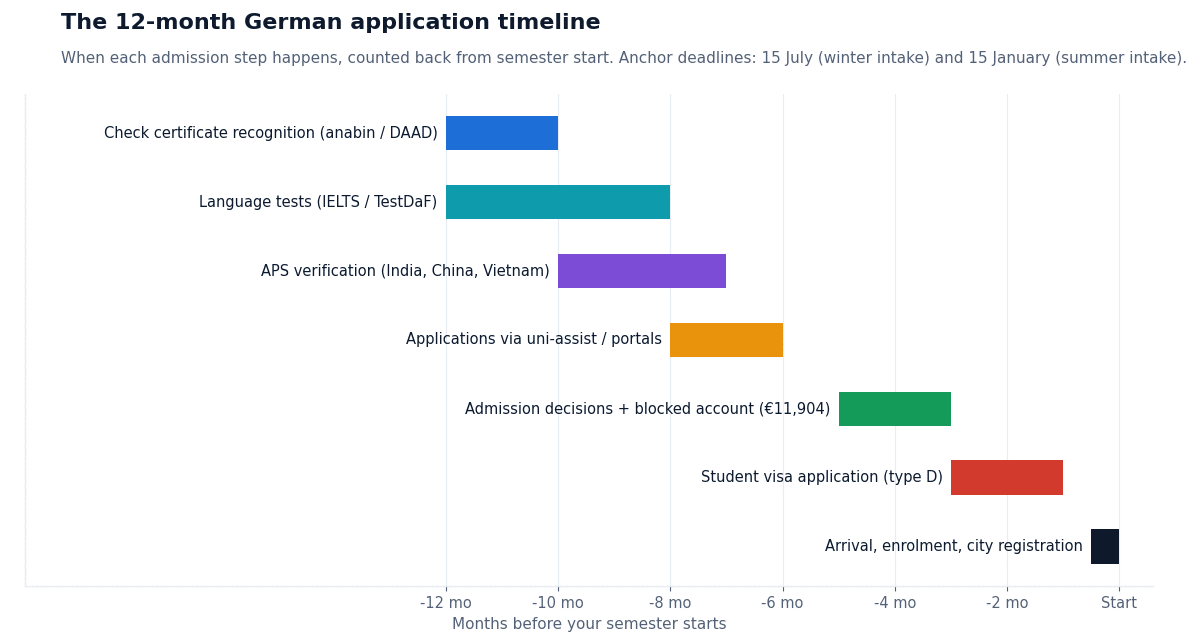
- 12+ months before intake: recognition check.Confirm in anabin/DAAD whether you qualify directly or need Studienkolleg; plan your language tests.
- 10–8 months: APS application.India, China, Vietnam: submit documents to your APS office and order multiple certificate copies.
- 8–6 months: uni-assist or direct applications.Submit 6–8 weeks before deadlines to leave room for the 4–6-week evaluation.
- 5–3 months: admission and blocked account.Accept your offer, deposit €11,904, arrange health insurance.
- 3–1 months: visa appointment.File the type-D application with APS certificate, admission letter, and blocking confirmation.
- Month 0: arrival.Enrol, register your address, convert the visa into a residence permit. Done.
Official Websites for the Gatekeeper Steps
Every gatekeeper in this guide has one authoritative website. Use these — fees and procedures on third-party sites are often outdated.
| Website | Run by | What you will find there |
|---|---|---|
| uni-assist | Official application service of German universities | The source for handling fees (€75 + €30), the standard-vs-VPD distinction, document checklists, and the My assist application portal itself. |
| APS India | Academic Evaluation Centre at the German Embassy, New Delhi | The official APS procedure for Indian applicants: the current fee (₹18,000), required documents, processing status, and certificate collection. Chinese and Vietnamese applicants use the APS pages of their local German embassy instead. |
| anabin | Standing Conference of the Ministers of Education (KMK) | The recognition database that decides whether you need a Studienkolleg at all — look up your certificate before planning anything else. |
| Federal Foreign Office — visa pages | Federal Foreign Office | The binding rules for the national student visa, the current blocked-account amount (€11,904 in 2026), accepted account providers, and links to every German mission’s appointment system. |
| KMK | Standing Conference of the Ministers of Education | The body behind certificate recognition and the Feststellungsprüfung (FSP) framework — useful when you need the formal rules underlying a Studienkolleg decision. |
| Study in Germany — study-in-germany.de | Federal Foreign Office + DAAD | Official step-by-step preparation guidance that ties all the gatekeepers together, kept current by the federal campaign team. |
All sites above are run by German federal bodies, the state ministers’ conference (KMK), or publicly funded organisations. Information there overrides anything you read elsewhere, including this guide.
Frequently Asked Questions
Do all German universities use uni-assist?
How much does uni-assist cost in 2026?
Can I apply to universities before my APS certificate arrives?
Is the APS certificate valid for future applications too?
Can I skip Studienkolleg with a JEE Advanced rank?
Is my blocked account money lost?
Accuracy note: fees, deadlines, and visa rules change. The figures in this article were verified in July 2026 (blocked account €11,904 / €992 per month, uni-assist €75 + €30, Baden-Württemberg €1,500 per semester, APS India ₹18,000). Always confirm the current rules on the official university, DAAD, or German-mission page before you act. Nothing here is a guarantee of admission, funding, or a visa.