
Study in France: Guide for International Students
This guide explains how to study in France as an international student for the 2026–2027 academic year. It covers the new differentiated tuition fees introduced by the May 2026 decree, the university system, English-taught options, real costs, scholarships, the VLS-TS student visa, and your right to work during and after your degree.
Why Study in France?
France combines heavily subsidised public universities, degrees recognised across Europe, and a government that has set a target of welcoming 500,000 international students by 2027 under its “Choose France for Higher Education” strategy.
Even after the 2026 fee reform, French public universities remain far cheaper than comparable destinations. The French state still covers roughly two-thirds of the real cost of every student’s education — Campus France puts that real cost at between €10,000 and more than €15,000 per student per year.
What is France known for academically?
Engineering and applied sciences through its grandes écoles, mathematics, physics, medicine, business, art and design, and the humanities. Public research organisations such as the CNRS, INSERM, INRIA, and CEA run laboratories jointly with universities, which is why so many doctoral positions in France are attached to a research unit rather than a department.
A quick comparison
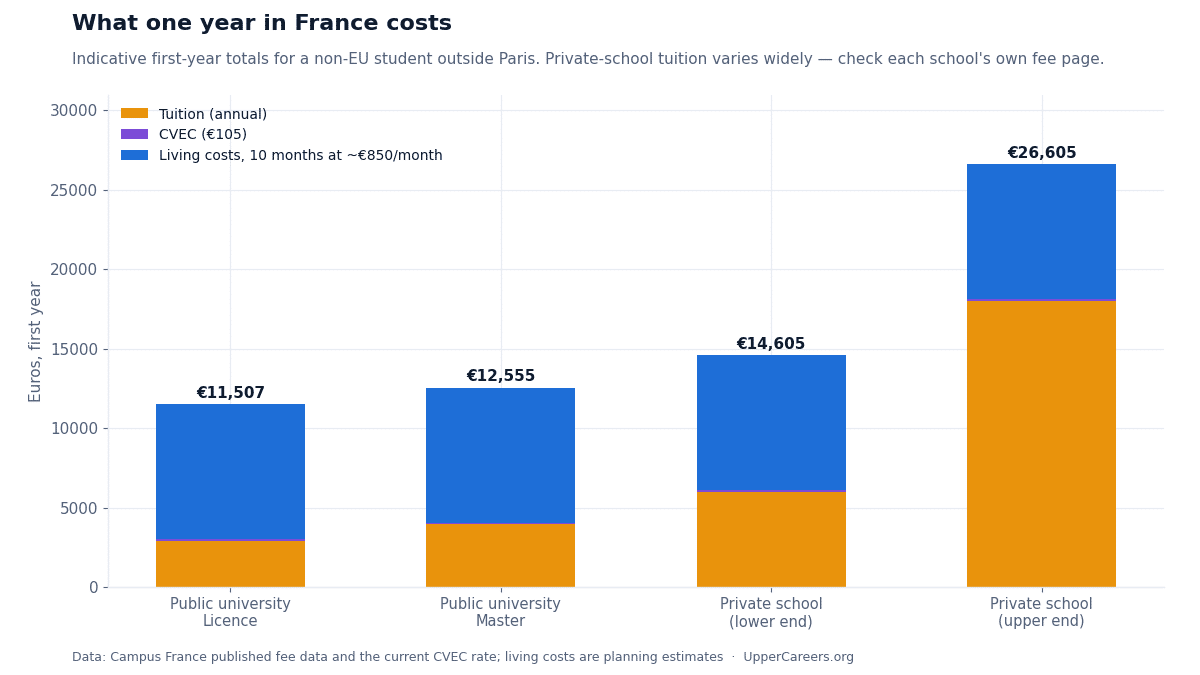
A non-EU student starting a Master’s in France in 2026–27 pays €3,950 per year in tuition at a public university. The same degree costs upwards of €20,000 per year in the United Kingdom, Australia, or the United States. France is more expensive than Germany, but it remains one of the lowest-cost high-quality destinations in the world.
How the French Higher Education System Works
France has three distinct types of institution. Choosing the right type matters as much as choosing the right city.
| Type | What it is | Entry | Typical fees (non-EU, public) |
|---|---|---|---|
| Université | Public, multidisciplinary, research-based; awards national degrees | Open or selective depending on the programme | €2,902 Licence · €3,950 Master |
| Grande école | Selective engineering, business or public-administration school | Competitive entrance exams or selective admission | Varies widely; several are outside the standard fee scale |
| Specialised school | Art, architecture, design, veterinary, paramedical | Portfolio, exam or interview | Set by the supervising ministry |
How do French degrees work?
France uses the European LMD system: Licence (3 years, 180 ECTS), Master (2 years, 120 ECTS), Doctorat (3 years). Engineering degrees (diplôme d’ingénieur) are Master-level qualifications, usually taking five years in total.
When does the academic year start?
The main intake is September, with a smaller January intake at some institutions. Because applications close months in advance — often between January and March for a September start — the planning year begins the autumn before you arrive.
What You Can Study: Degree Levels
France has an entry route at every stage of an academic career.
- Licence (Bachelor’s) — three years; taught almost entirely in French, with entry through Parcoursup, the DAP procedure, or Études en France. Read the full Licence guide.
- Master — two years; the level with the widest choice of English-taught programmes and the level that unlocks the 12-month post-study permit. Read the full Master’s guide.
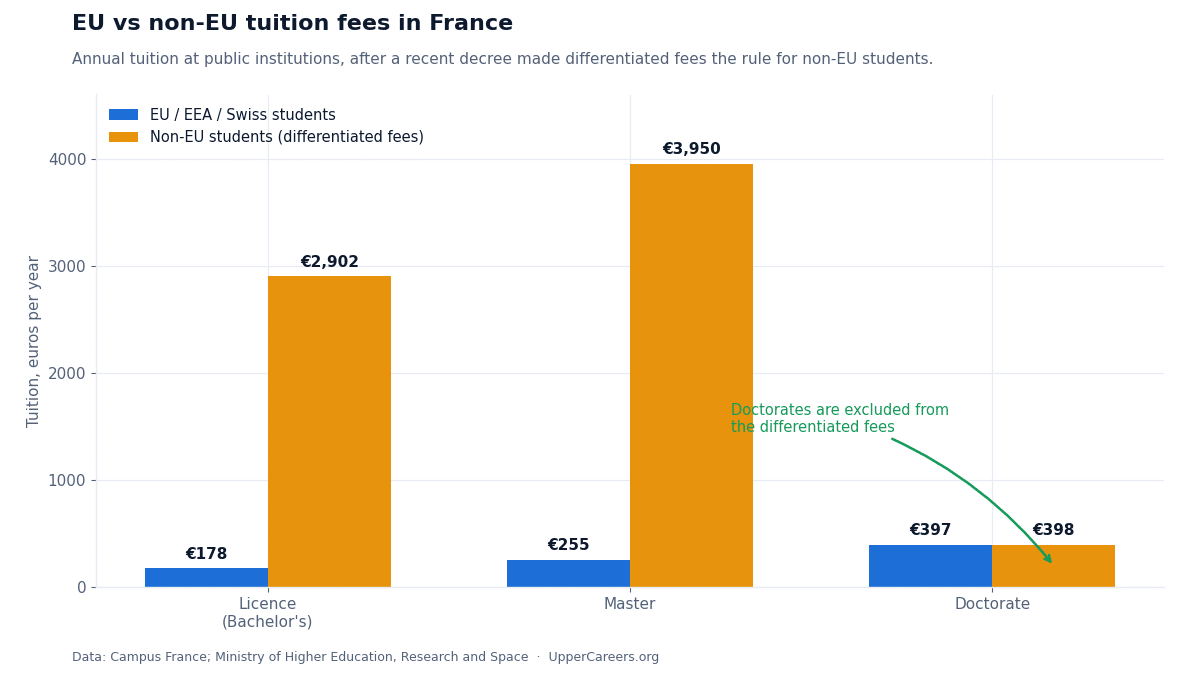
- Doctorat (PhD) — three years, normally on a salaried employment contract worth €2,300 gross per month, and exempt from the differentiated fees. Browse live PhD, postdoc, and faculty openings on the UpperCareers jobs board, or find a matching supervisor with the Supervisor Finder. Read the full PhD guide.
- French language courses and preparatory years — for applicants who need to reach B2 French before starting a degree.
Language: French or English?
Can I study in France in English?
Yes, but mainly at Master’s level and in grandes écoles and business schools. Campus France maintains a dedicated catalogue of programmes taught entirely in English. At Licence level the offer is far smaller, and most undergraduate teaching is in French.
What French level do I need?
French-taught degrees normally require B2 on the Common European Framework, proven with a DELF/DALF diploma or a TCF/TEF test score. Some programmes ask for C1. If you enrol in an English-taught programme you may not need French for your classes — but you will need it for housing, administration, part-time work, and the job market afterwards.
| Study language | Accepted proof | Typical requirement |
|---|---|---|
| French-taught | DELF/DALF, TCF, TEF | B2 (some programmes C1) |
| English-taught | IELTS Academic, TOEFL iBT | Set by each programme — check the admission page |
What It Costs in 2026–2027
What changed in 2026?
A decree published on 19 May 2026 (Decree No. 2026-385) made differentiated tuition fees the standard for non-EU students and sharply limited the waivers universities may grant. Non-EU students starting a Licence in 2026–27 pay €2,902 per year and Master’s students pay €3,950 — while EU, EEA and Swiss students pay €178 and €255.
What is the CVEC?
Every student in initial training must pay the Contribution Vie Étudiante et de Campus before enrolling. For 2026–2027 it is €105, paid once per year on the government’s CVEC site; it funds campus health, sport, culture and social services. French government scholarship holders are exempt.
Total first-year budget
Scholarships and Funding
French government scholarships matter more than ever in 2026, because a French government scholarship also brings an automatic full tuition waiver.
- France Excellence Eiffel — the flagship programme of the Ministry for Europe and Foreign Affairs. From January 2026 it pays €1,200 per month at Master’s level and €2,100 per month at doctoral level, plus travel, insurance and housing support. Tuition is not covered. Applications are submitted only by the French institution, not by the student, and age limits apply (29 at Master’s, 35 at doctoral level).
- French government scholarships (BGF) — awarded through French embassies and Campus France offices; holders receive an automatic full tuition-fee waiver and are exempt from the CVEC.
- Institutional scholarships — many universities and grandes écoles run their own merit awards for international students.
- Erasmus+ — for exchange periods and joint European Master’s programmes.
Under the 2026 reform the government said around 60% of scholarships would be directed towards priority fields such as digital technology and artificial intelligence, quantum, and biotechnology — worth knowing when you choose your subject.
The French Student Visa
Which visa do I need?
Non-EU students staying longer than six months need the VLS-TS — a long-stay visa that doubles as a residence permit once you validate it online after arrival. EU, EEA and Swiss citizens need no visa.
What do I have to prove?
- Admission to a recognised French institution
- Financial resources of at least €615 per month for your stay — Campus France’s stated minimum, provable by bank statements, a scholarship certificate, or a sponsor’s guarantee
- Accommodation arrangements and health cover
- For applicants in Études en France countries: a completed EEF file
After you arrive
You must validate your VLS-TS online through the government’s ANEF portal within three months of arrival, and pay the residence tax stamp. Skipping this step makes your stay irregular even though your visa is valid — it is the single most common administrative mistake international students make in France.
Working During and After Your Studies
Can I work while studying?
Yes. A student residence permit allows up to 964 hours per year — about 20 hours a week — with no separate work permit needed.
What happens after graduation?
Graduates at Master’s level (and holders of a licence professionnelle) can apply for the “recherche d’emploi ou création d’entreprise” residence permit under Article L.422-10 of the CESEDA. It lasts 12 months, is not renewable, and lets you look for a job connected to your studies or set up a business. You must apply before your student permit expires.
Campus France notes that until you sign a work contract you may work under the same conditions as a student. Once you hold a job linked to your training that pays above the threshold set by the government (currently a gross monthly salary of more than €2,734.55), your employer is exempt from applying for a work permit and the 964-hour cap no longer applies.
Longer-term options
From there, most graduates move to a salaried work permit or to the Passeport Talent, which is designed for qualified employees, researchers and founders and can be issued for up to four years.
Official Websites Every Applicant Should Bookmark
These are the government and publicly funded websites behind almost every fact in this guide. Use them to verify anything before you act.
| Website | Run by | What you will find there |
|---|---|---|
| Campus France | National agency for higher education promotion (Ministries of Europe and Foreign Affairs, and of Higher Education) | The central portal for international students: the programme catalogue, current tuition figures, scholarship pages, visa explanations, and the network of Campus France offices in your own country. |
| Études en France | Ministry for Europe and Foreign Affairs, operated by Campus France | The platform where non-EU applicants in covered countries build their academic file, choose programmes, book the Campus France interview, and have their file forwarded to the consulate. |
| etudiant.gouv.fr | Ministry of Higher Education, Research and Space, with the CROUS network | Official student services in one place: enrolment rules, the CVEC, housing and grants, doctoral funding, and the calendar of the academic year. |
| enseignementsup-recherche.gouv.fr | Ministry of Higher Education, Research and Space | The source of the tuition decrees themselves, including the official FAQ on differentiated fees for non-EU students and the list of recognised institutions. |
| France-Visas | Ministry for Europe and Foreign Affairs | The official visa portal: a wizard that tells you which visa you need, the exact document list for your nationality, current fees, and where to submit your application. |
| service-public.fr | Directorate of Legal and Administrative Information (DILA) | The government’s plain-language explanation of your rights: the 964-hour work limit, the post-study job-search permit, and the salary thresholds that exempt an employer from applying for a work permit. |
Every site above is run by a French ministry, a public agency, or a publicly funded body. Where these sites and this guide ever differ, the official site is right.
Frequently Asked Questions
How much does it cost to study in France in 2026?
Why did French tuition fees change in 2026?
Can I study in France in English?
How much money do I need for a French student visa?
Can international students work in France?
Can I stay in France after graduating?
Accuracy note: French tuition, visa and residence rules changed significantly in 2026 and can change again. The figures here were verified in August 2026 against Campus France and French government sources (2026–2027 fees of €2,902 / €3,950 / €398, the €105 CVEC, the €615 monthly proof of funds, and the €2,300 doctoral contract). Always confirm the current rules on the official Campus France, ministry, or France-Visas page before you act. Nothing here is a guarantee of admission, funding, or a visa.