Master’s in France: Fees, Eligibility & Application
This guide explains how to get a Master’s in France as an international student. It covers how the two-year French Master’s is structured, how admission committees actually decide, applying through Mon Master or Études en France, English-taught programmes, the tuition now charged to non-EU students, the Eiffel scholarship, and the twelve-month job-search permit that follows graduation.
About the French Master’s Degree
How long is a Master’s in France?
Two years — M1 and M2 — for a total of 120 ECTS credits, ending with a dissertation or an internship report. Entry into M1 is the main national admission round; entry directly into M2 is handled programme by programme.
Research track or professional track?
Most French Master’s programmes specialise in the second year. The research track is built around a supervised dissertation and a laboratory placement, and is the normal gateway to a doctorate. The professional track is built around an internship of four to six months in a company or organisation, and is aimed at direct employment.
Choose deliberately. If you intend to do a PhD in France, doctoral schools look for a research-track M2 with a genuine dissertation; a professional M2 can make the doctoral application noticeably harder, however good your grades.
Where the Master’s sits in the system
| Qualification | Awarded by | Notes |
|---|---|---|
| Master (diplôme national) | Universities | The standard two-year degree, admission through the national platform |
| Diplôme d’ingénieur | Engineering schools | Recognised at Master’s level; five years in total including preparatory study |
| Grande école programmes | Business and management schools | Own admission procedures and fee scales |
| Mastère spécialisé and MSc | Grandes écoles | School-accredited qualifications, not national degrees — check what you are buying |
How the two years differ
M1 is broad and taught, re-establishing a common foundation across students who arrive from different Licence programmes. M2 is narrow, specialised, and dominated by either the dissertation or the internship. Many students underestimate how much M2 depends on securing a placement or supervisor early — in practice that search begins during M1, not after it.
Finding the Right Programme
How admission decisions are actually made
French Master’s admission is selective and decided primarily on academic fit: committees compare the subjects you actually studied in your Bachelor’s against the syllabus of the M1. A strong file in a closely matching subject beats a brilliant file in a distant one.
This has a practical consequence. Before applying, write out your completed modules with their credit weights and place them next to the programme’s stated prerequisites. Where there is a gap, address it explicitly in your motivation letter rather than hoping the committee will not notice.
Which institutions are strong in my field?
Rather than relying on general rankings, look at where the research units are. French universities host laboratories jointly with the CNRS, INSERM, INRIA, CEA and INRAE, and the presence of a relevant laboratory tells you far more about a department’s depth than any league table. A programme attached to an active research unit also has better internship networks and better doctoral routes.
Are there English-taught Master’s programmes?
Yes — this is the level where France’s English-taught offer is concentrated, especially in engineering, computer and data science, economics and management, and international relations. Campus France maintains a catalogue specifically for programmes taught in English.
Public university or grande école?
| Public university | Grande école / business school | |
|---|---|---|
| Tuition for non-EU students | €3,950 per year | Set by the school; frequently far higher |
| Admission | National platform or Études en France | Direct application, sometimes with tests or interviews |
| Strengths | Research depth, breadth of subjects, cost | Corporate networks, careers services, cohort size |
| Best for | Research careers, science and humanities | Management, finance, specialised professional tracks |
Eligibility
What qualification do I need?
A completed Bachelor’s degree worth 180 ECTS in a subject relevant to the Master’s you want. French institutions assess foreign degrees individually — there is no central equivalence database, so each programme’s admission committee decides.
Is a three-year Bachelor’s enough?
Yes. France’s own Licence is a three-year, 180-ECTS degree, so a three-year Bachelor’s is the standard entry qualification rather than a problem. This is the opposite of the concern many applicants carry over from destinations that expect four years.
What about grades?
There is no single national threshold. Selective programmes in oversubscribed fields effectively require a strong record, while less competitive programmes are more flexible. Because French marking runs out of 20 with 10 as the pass, committees are used to converting foreign scales and will read your transcript in context — including the class rank or grading distribution if you can supply it.
Language requirements
French-taught Master’s programmes normally require B2, sometimes C1, evidenced with DELF/DALF, TCF or TEF. English-taught programmes set their own IELTS or TOEFL thresholds. Requirements vary far more between programmes than between universities, so read the specific admission page rather than assuming an institutional standard.
Do I need the GRE or work experience?
Generally no. The GRE plays almost no role in French admissions. Work experience matters mainly for executive programmes, specialised management degrees, and some MBA-style qualifications — not for standard M1 entry.
How to Apply
Which platform you use depends on where you live when you apply.
| Your situation | Route |
|---|---|
| Non-EU student living in a country covered by Études en France | Études en France, through your Campus France country office |
| EU, EEA or Swiss student, or a foreign student already living in France or the EEA | Mon Master (monmaster.gouv.fr) |
| Non-EU student in a country not covered by Études en France | Mon Master, or direct application where the institution requires it |
| Entry directly into the second year, or a grande école | Direct application to the institution |
What Mon Master is
Mon Master is the government’s single national platform for first-year Master’s admission, run by the Ministry of Higher Education and Research. It lists over 3,500 national Master’s degrees and thousands of pathways into them, and it runs on one national calendar: an information phase, an application window that opens in mid-February and closes in mid-March, results in the late spring, and a complementary round over the summer for applicants who received no offer.
Because the calendar is national and synchronised, everyone receives their answers at the same time. If you receive several offers you may keep only one, and missing a reply deadline is treated as a refusal.
What documents will I need?
- Bachelor’s degree certificate and full transcripts, with certified French or English translations
- A motivation letter written for that specific programme — generic letters are visible immediately
- CV, and letters of reference where the programme asks for them
- Language certificate — DELF/DALF, TCF or TEF for French; IELTS or TOEFL for English-taught
- Passport, and for EEF applicants the completed Études en France file
Writing a motivation letter that works
French committees are reading for coherence, not enthusiasm. A letter that works usually does four things in a page: names the specific modules or research themes of that programme, connects them to what you have already studied with concrete evidence, explains the professional or research direction they serve, and addresses any gap in your file directly. Praise for the university’s reputation adds nothing.
The sequence
- Autumn: build your shortlist.Match your Bachelor’s syllabus against each M1’s requirements and book your language test early.
- Open your Études en France account, or prepare for Mon Master.EEF applicants complete the online file and attend a Campus France interview.
- Apply within the national window.Mon Master opens for applications in mid-February and closes in mid-March; Études en France has its own country deadlines.
- Answer your offers.Keep only one. Diarise the reply deadline the day results are published.
- Apply for the VLS-TS visa.Show €615 per month of resources, and apply as soon as admission is confirmed.
- Pay the €105 CVEC and enrol.The certificate is required before the institution can complete your registration.
- Arrive and validate your visa on ANEF.Within three months of arrival, or your stay becomes irregular.
Studying in French or English
Can I complete a Master’s entirely in English?
Yes. English-taught Master’s programmes are widely available in engineering, computer and data science, economics and management, and international studies, at both public universities and grandes écoles.
Do I still need French?
For daily life and for the job search afterwards, yes. Employers hiring in France mostly expect working French, and the twelve-month post-study permit is far more valuable to a graduate who can interview in French. Reaching B1 or B2 across two years is a realistic target, and many universities offer free or subsidised French classes to international students.
The internship problem
This is the practical reason to learn French even in an English-taught programme. Professional-track Master’s degrees require an internship, and most French host organisations work in French. Students who cannot operate in French find their internship options narrowed to international companies and research laboratories — which is a real constraint in a competitive placement market.
Fees, Budget and Funding
What is the tuition?
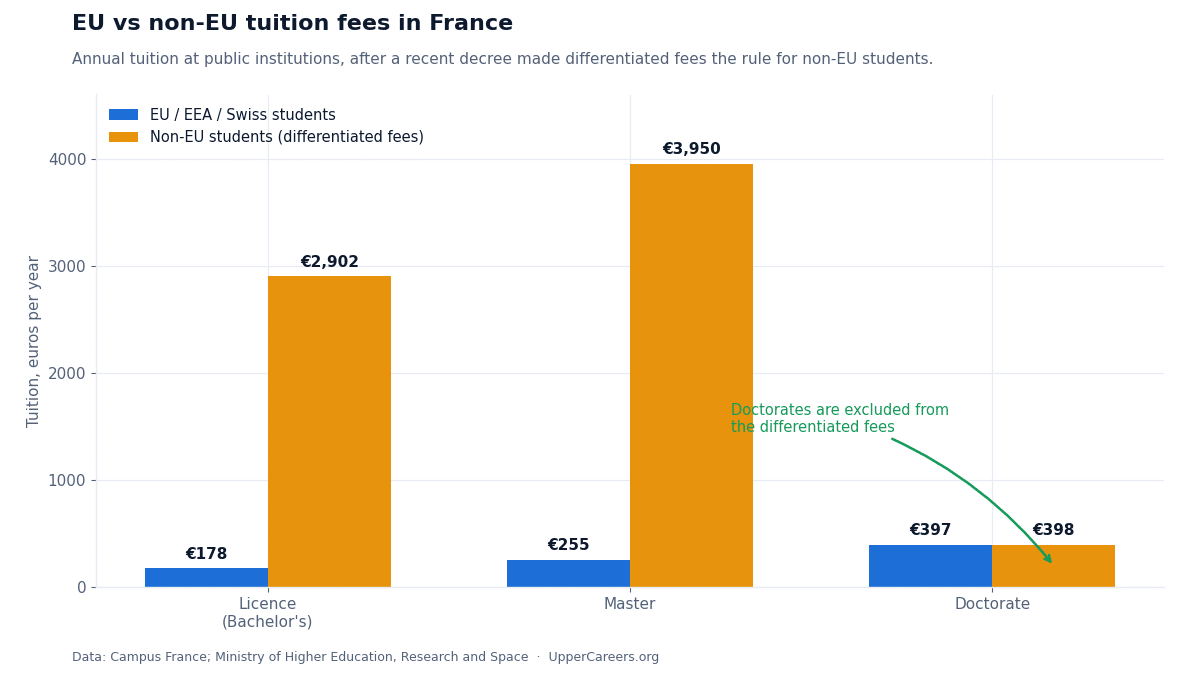
Non-EU students enrolling for the first time in a Master’s at a public institution pay €3,950 per year, against €255 for EU, EEA and Swiss students. The €105 CVEC applies to everyone. Private institutions and business schools charge their own fees, commonly from about €6,000 to €18,000 or more.
Which scholarships fund Master’s students?
- France Excellence Eiffel — €1,200 per month, plus travel and insurance, for up to two years at Master’s level. Tuition is not covered, only the French institution can submit your application, and candidates already living in France are not eligible.
- French government scholarships — carry an automatic full tuition waiver and CVEC exemption; awarded through embassies and Campus France offices in your own country.
- Institutional and regional scholarships — awarded by universities, grandes écoles and some regional authorities, and usually less competitive because fewer applicants find them.
- Erasmus Mundus — fully funded joint Master’s programmes involving a French partner institution.
Can I work during my Master’s?
Yes — 964 hours per year, about 20 hours a week. In professional-track programmes the four-to-six month internship is paid a legal minimum gratification above a threshold duration, and internships are among the strongest routes into a first job offer in France. Working-student arrangements, where you combine study with a part-time role in your field, are also increasingly common.
A realistic two-year budget
Outside Paris, a Master’s student paying €3,950 tuition, €105 CVEC and around €850 a month in living costs spends roughly €12,500 in an academic year. Two years therefore come to about €25,000 before travel — considerably less than one year at many English-speaking destinations, and a figure that part-time work and a paid internship can meaningfully reduce.
Career After Your Master’s
What are my options at graduation?
Master’s graduates can apply for the “recherche d’emploi ou création d’entreprise” residence permit under Article L.422-10 of the CESEDA: twelve months, non-renewable, to find work related to your studies or start a business. You must apply before your student permit expires.
From job search to work permit
Once you hold a job linked to your training with a gross monthly salary above the government threshold — currently more than €2,734.55 — your employer does not need to apply for a work permit, and the student 964-hour cap no longer applies. From there the usual next steps are a salaried work permit or the Passeport Talent, which can be issued for up to four years to qualified employees, researchers and founders.
How to use the twelve months well
The permit is short and cannot be renewed, so the search realistically begins during your final semester, not after graduation. The strongest positions to be in are: an internship that can convert into an offer, a professional network built through your programme, and enough French to interview. Graduates who wait until the diploma arrives before starting to apply lose a third of the window immediately.
Thinking about a doctorate instead?
A French research-track M2 is the standard gateway into a funded French doctorate — and doctoral candidates are exempt from the differentiated tuition fees. See the PhD in France guide, browse live openings on the UpperCareers jobs board, and identify potential supervisors with the Supervisor Finder.
Official Websites for Master’s Applicants
Bookmark these before you shortlist a single programme — they are the primary sources behind this guide.
| Website | Run by | What you will find there |
|---|---|---|
| Mon Master | Ministry of Higher Education, Research and Space | The single national platform for first-year Master’s admission: over 3,500 national Master’s degrees, one application calendar, and synchronised replies. |
| Études en France | Ministry for Europe and Foreign Affairs, operated by Campus France | The platform where non-EU applicants in covered countries build their academic file, choose programmes, book the Campus France interview, and have their file forwarded to the consulate. |
| Campus France | National agency for higher education promotion (Ministries of Europe and Foreign Affairs, and of Higher Education) | The central portal for international students: the programme catalogue, current tuition figures, scholarship pages, visa explanations, and the network of Campus France offices in your own country. |
| France Excellence Eiffel | Ministry for Europe and Foreign Affairs, managed by Campus France | Rules, amounts and the annual calendar for France’s flagship scholarship: €1,200 a month at Master’s level and €2,100 at doctoral level. Only your institution can submit the application. |
| France-Visas | Ministry for Europe and Foreign Affairs | The official visa portal: a wizard that tells you which visa you need, the exact document list for your nationality, current fees, and where to submit your application. |
| service-public.fr | Directorate of Legal and Administrative Information (DILA) | The government’s plain-language explanation of your rights: the 964-hour work limit, the post-study job-search permit, and the salary thresholds that exempt an employer from applying for a work permit. |
Every site above is run by a French ministry, a public agency, or a publicly funded body. Where these sites and this guide ever differ, the official site is right.
Frequently Asked Questions
How much is a Master's in France for international students?
Is a three-year Bachelor's degree enough for a French Master's?
What is Mon Master?
Do I need the GRE to study a Master's in France?
What is the Eiffel scholarship worth?
Can I work in France after my Master's?
Accuracy note: French tuition, visa and residence rules changed significantly in the most recent reform and can change again. The figures in this guide — tuition of €2,902, €3,950 and €398, the €105 CVEC, the €615 monthly proof of funds, the 964-hour work limit and the €2,300 doctoral contract — were checked against Campus France and French government sources when this article was last updated. Always confirm the current rules on the official Campus France, ministry, or France-Visas page before you act. Nothing here is a guarantee of admission, funding, or a visa.