PhD in France: Funding, Salary, Visa & Application
This guide explains how to do a PhD in France. It covers the doctoral contract that pays a legal minimum of €2,300 gross per month, why doctoral candidates are exempt from France’s differentiated tuition fees, how doctoral schools and laboratories work, how to find and approach a supervisor, the funding routes, the Passeport Talent researcher visa, and a realistic twelve-month application timeline.
How French Doctorates Work
Is a French PhD a job or a course?
Usually a job. The standard funding route, the contrat doctoral, is a three-year employment contract with a legal minimum salary of €2,300 gross per month — roughly €1,850 net — carrying full employee rights including social security, twenty-five days of paid leave, and unemployment rights when the contract ends.
What does a French doctorate cost?
Very little, and this is one of the most under-reported facts about studying in France. Doctoral programmes are excluded from the differentiated tuition fees introduced for other levels, so a non-EU doctoral candidate pays €398 per year — almost identical to the €397 paid by EU students — plus the €105 CVEC. A funded doctorate in France therefore costs you close to nothing while paying a salary.
The four structures you need to understand
| Element | What it is | What it means for you |
|---|---|---|
| École doctorale | The doctoral school | It admits you, registers you each year, and sets the training you must complete. You apply to it, not to a department. |
| Laboratoire / unité de recherche | The research unit where you work | Often run jointly by a university and a national research organisation such as the CNRS or INSERM. |
| Directeur de thèse | Your supervisor | Must formally agree to supervise you before the doctoral school will even consider your file. |
| Comité de suivi | Annual monitoring committee | Reviews your progress each year and must approve your re-registration. |
How long does it take?
Three years is the legal standard and the length of the doctoral contract. Extensions happen, particularly in the humanities and social sciences, but funding rarely extends with them — which is why finishing within the contract matters more in France than in systems where a fourth or fifth year is routine. Ask any prospective laboratory what proportion of its candidates defend within three years; the answer is informative.
What the training component involves
Beyond research, doctoral schools require a number of training hours: research methods, ethics and scientific integrity, teaching skills, languages, and transferable skills for careers outside academia. These are not optional, and they are one reason the French doctorate is treated as a professional qualification rather than purely an academic apprenticeship.
Finding a Supervisor and a Position
In France, nothing moves until a supervisor agrees to take you. The doctoral school will not process a file without the named agreement of a directeur de thèse, so identifying the right researcher is the first task, not the last.
Three ways in
- Advertised, funded thesis subjects. Laboratories publish specific doctoral projects with funding already attached, and you apply as you would for a job. Browse live postdoctoral, faculty and PhD positions from universities worldwide on the UpperCareers jobs board.
- Doctoral school competitions. Many écoles doctorales run an annual competition for a fixed number of doctoral contracts, with candidates ranked by a jury after interview. Deadlines cluster in the spring for an autumn start.
- Approaching a supervisor with your own project. Possible, and common in the humanities, but you and your prospective supervisor will still need to secure funding through a competition, an agency grant, or a company partnership.
How to find the right researcher
This is the hard part, and it is what our tools are built for. The UpperCareers Supervisor Finder searches 347,467 active researchers worldwide by research topic, university, or country, with every match scored and explained — so you can see who genuinely publishes in your field at a given French laboratory instead of guessing from a departmental staff list.
Writing to a potential supervisor
Keep it short and specific. Name the paper of theirs your idea builds on, state what you would add, and attach a one-page project outline and your CV. A concrete opening works: “Your recent paper on X leaves open the question of Y; my Master’s dissertation developed method Z, which could address it.” Generic mass emails are ignored everywhere, and French laboratories are no exception.
Questions to ask before you accept
- Is the funding confirmed, and is it a contract or a scholarship?
- How many doctoral candidates does the supervisor currently have?
- What proportion of the group’s candidates defend within three years?
- What are the co-authorship conventions in the laboratory?
- Will the contract include teaching, and is it paid separately?
Eligibility
What do I need to apply?
A Master’s degree or an equivalent qualification worth 300 ECTS, including a research component. In practice a research-track M2 with a supervised dissertation is the profile doctoral schools expect.
Can I apply with a foreign Master’s?
Yes. The doctoral school assesses your qualification directly, and there is no separate national equivalence step. Where your degree structure differs from the French one, the strength of your research experience and the quality of your Master’s-level dissertation usually decide the outcome. Some doctoral schools can admit candidates without a Master’s by special dispensation, but this is rare and requires an exceptional research record.
What committees weigh
- The quality, originality and feasibility of your research project
- The fit between your project and the laboratory’s actual programme of work
- Your academic record, and any publications or conference contributions
- Reference letters, particularly from your Master’s dissertation supervisor
- Your ability to explain the project clearly at interview, including its limitations
Building a research project that convinces
A strong proposal is narrow, answerable within three years, and visibly connected to what the laboratory already does. Two pages that pose one precise question, explain the method, identify the data or materials required, and sketch a realistic year-by-year plan will beat ten pages of ambition. French juries are particularly attentive to feasibility — a project that cannot be completed in three years is a project that will be declined.
Application Timeline
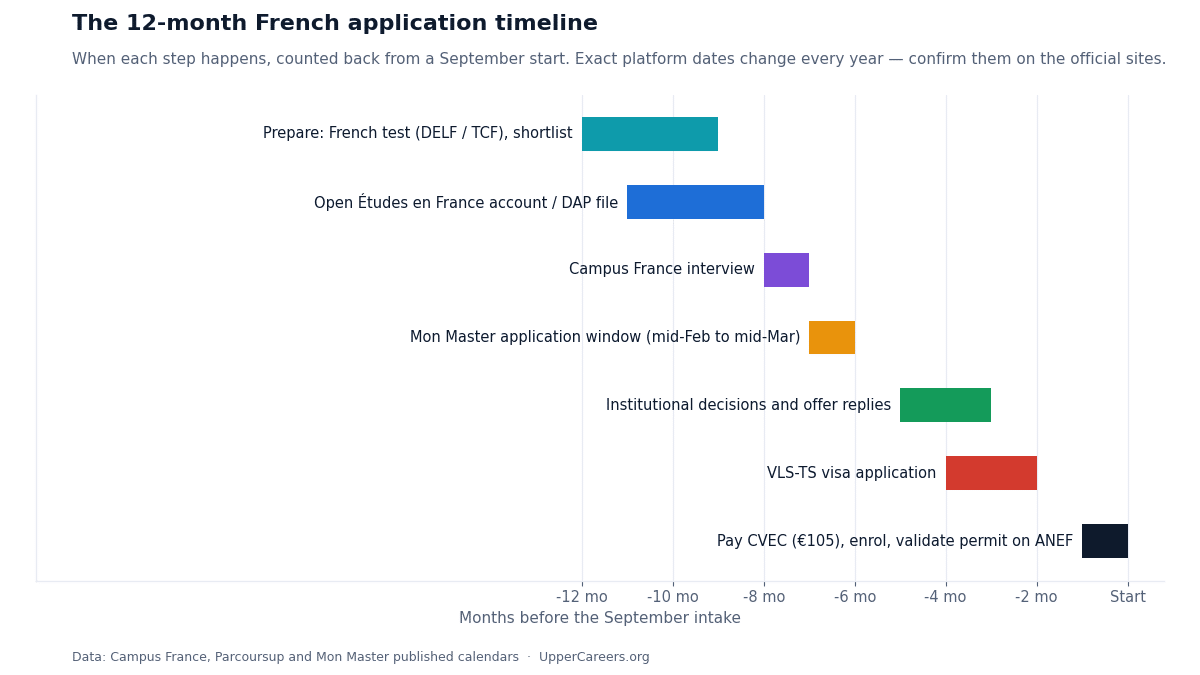
- About twelve to ten months ahead: define the project.Draft a one-to-two page outline and list the French laboratories whose published work it extends.
- Ten to eight months: contact supervisors.Write to potential directeurs de thèse, and apply to advertised funded subjects as they are published.
- Eight to six months: the doctoral school competition.With your supervisor’s written agreement, submit to the école doctorale competition. Interviews are usually held in spring for an autumn start.
- Six to four months: funding confirmed and file registered.Contract offer or scholarship award, then formal registration by the doctoral school.
- Four to two months: visa.Apply for the Passeport Talent – Chercheur if you have a hosting agreement, or the VLS-TS if you are enrolling as a student.
- Arrival: register and begin.Sign your contract, validate your permit on ANEF, pay the €398 registration and the €105 CVEC, and start in the laboratory.
Why the timeline is unforgiving
Each stage depends on the previous one and none can be compressed. A supervisor who replies in three weeks, a competition that interviews two months later, a prefecture that takes six weeks — the individual delays are reasonable, but they accumulate. Candidates who begin the search in spring for an autumn start almost always end up waiting a full year.
Language Requirements
Can I do a PhD in France in English?
In most experimental and quantitative fields, yes. Laboratory work, seminars and publications are largely in English, and many doctoral schools accept a thesis written in English with a substantial summary in French.
Where French is unavoidable
Humanities, law and most social-science doctorates expect French, both for the sources and for the defence. Even in the sciences, French is needed for administration, for teaching duties if your contract includes them, and for daily life outside the laboratory.
Learning French during the doctorate
Doctoral schools frequently offer French courses as part of the training credits you must complete anyway, which makes this one of the easier systems in which to learn the language while working. Candidates who reach a working level of French find the annual monitoring committee, the defence formalities and the eventual job search substantially easier.
Funding and Salary
What does a French doctoral candidate earn?
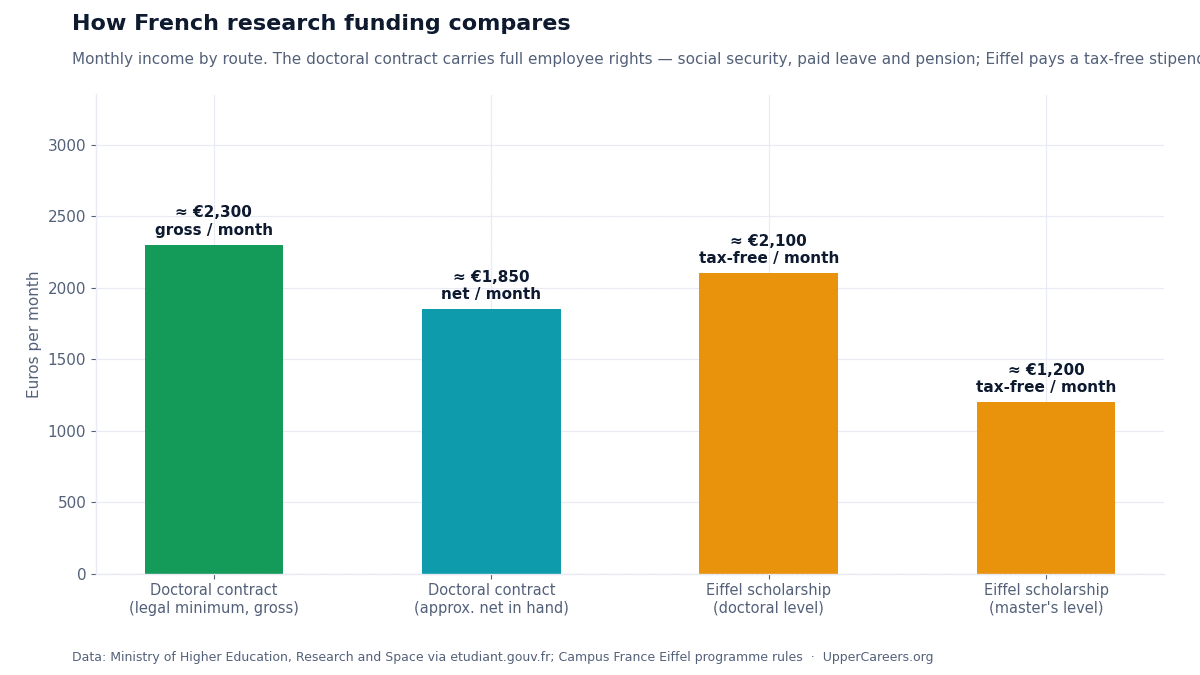
The doctoral contract sets a legal minimum of €2,300 gross per month, about €1,850 net. It is a genuine employment contract: you accrue pension rights, paid leave, sick pay, and entitlement to unemployment benefit at the end of the contract.
The main funding routes compared
| Route | What it is | Status |
|---|---|---|
| Contrat doctoral | Three-year public employment contract, minimum €2,300 gross per month | Full employee rights |
| CIFRE | Doctorate carried out inside a company, partnered with an academic laboratory | Employment contract with the company, often above the public minimum |
| Eiffel doctoral scholarship | €2,100 per month plus travel and insurance, for joint or co-supervised theses | Scholarship; tuition not covered, no employment status |
| Agency, regional or foreign funding | Project funding, regional doctoral grants, or a scholarship from your home country | Varies — check whether it produces a contract or a stipend |
| Self-funded | No dedicated funding | Permitted in some schools but strongly discouraged; visa proof of funds still applies |
Contract or scholarship — why it matters
A contract makes you an employee: social security, pension contributions, paid leave and unemployment entitlement all follow automatically. A scholarship pays a tax-free stipend but does not carry the same protections. When comparing two offers, compare status as carefully as amount — a slightly lower contract can be worth more than a higher stipend over three years.
Teaching and supplementary work
Doctoral contracts can include complementary activities such as teaching, scientific outreach or expertise work, for which an additional payment is made on top of the base salary. Teaching is also useful evidence if you intend to apply for academic posts later.
Visa, Residence and Family
Which permit applies?
| Your situation | Permit | Why it matters |
|---|---|---|
| You hold a hosting agreement (convention d’accueil) with a research institution | Passeport Talent – Chercheur | Multi-year permit; an accompanying spouse receives a permit that allows them to work |
| You are enrolled as a doctoral student without a hosting agreement | VLS-TS student visa | Standard student conditions, including the 964-hour work limit |
The hosting agreement
The convention d’accueil is issued by an approved research institution and is what converts you from a student in the eyes of the administration into a researcher. If your funding takes the form of a contract, ask the laboratory’s administration for it early — it materially improves your immigration status and your family’s rights.
Bringing your family
The researcher route is far more family-friendly: accompanying spouses receive a permit that allows them to work, which is not the case on the standard student route. Children can be enrolled in French schools, which are free at public level.
Validation after arrival
Whichever permit you hold, complete the online validation through the government’s ANEF portal within three months of arriving in France. This step is easy to overlook when you are starting in a laboratory, and it causes real problems later if missed.
Daily Life as a Doctoral Researcher
Can I live on the salary?
A net income of about €1,850 covers a comfortable life in Lyon, Toulouse, Montpellier, Rennes or Lille, where rents run well below Paris levels. In Paris the same salary is workable but tight — institutional or CROUS housing makes a substantial difference, and many laboratories can help with applications.
What is the working culture like?
Supervision styles vary more between laboratories than between universities. The annual comité de suivi gives you a formal checkpoint that many systems lack, and it is a genuine protection: it is the mechanism through which a struggling supervision relationship can be raised without confrontation.
Before you accept an offer
Speak to current doctoral candidates in the group, not only the supervisor. Ask about weekly rhythms, how often the supervisor reads drafts, whether the laboratory funds conference travel, and what happened to the last three people who finished. These conversations are normal and expected in France, and a supervisor who discourages them is telling you something.
After the Doctorate
French doctoral graduates move into academic postdocs, public research organisations such as the CNRS and INSERM, or industry research and development — and the Passeport Talent route makes staying in France after the thesis considerably simpler than the standard student path.
The academic route
Postdoctoral positions are advertised year-round by universities and research organisations. Permanent research posts at the CNRS, INSERM, INRAE and INRIA, and lecturer posts at universities, are filled through annual national competitions with formal application windows — a system that rewards planning and early qualification.
The industry route
The CIFRE scheme exists precisely to build bridges into industry, and candidates who take that route typically move into company positions quickly. Beyond CIFRE, doctorates are well regarded in French research-intensive sectors including aerospace, pharmaceuticals, energy, and software.
Where to look
- Postdoctoral positions — browse current openings on the UpperCareers jobs board, and use the Supervisor Finder to identify groups whose work matches yours.
- Public research organisations — each runs its own official recruitment portal for doctoral, postdoctoral and permanent posts.
- Industry — research-intensive employers recruit doctoral graduates directly, often through laboratory partnerships.
Official Websites for Doctoral Applicants
French doctoral information is spread across several official portals. These are the ones worth your time.
| Website | Run by | What you will find there |
|---|---|---|
| Campus France Doctorate portal | Campus France | A searchable directory of French doctoral schools and of funded thesis subjects currently open to applications. |
| etudiant.gouv.fr | Ministry of Higher Education, Research and Space, with the CROUS network | Official student services in one place: enrolment rules, the CVEC, housing and grants, doctoral funding, and the calendar of the academic year. |
| Passeport Talent — Chercheur | Campus France, for the Ministry of the Interior | The residence permit for doctoral candidates and researchers with a hosting agreement, including the rules on multi-year validity and your spouse’s right to work. |
| EURAXESS France | European Commission researcher network, French node | Research job listings plus practical guidance on contracts, social security, and the researcher visa for people moving to France. |
| CNRS careers | Centre National de la Recherche Scientifique (public research organisation) | Doctoral, postdoctoral and permanent research vacancies at France’s largest public research organisation. INSERM, INRAE and INRIA run equivalent official portals. |
| Agence Nationale de la Recherche | National research funding agency | How French research projects are funded — useful for understanding where a laboratory’s money, and therefore its doctoral positions, come from. |
Every site above is run by a French ministry, a public agency, or a publicly funded body. Where these sites and this guide ever differ, the official site is right.
Frequently Asked Questions
Is a PhD in France paid?
Do PhD students pay the new differentiated tuition fees in France?
Do I need a Master's degree for a French PhD?
How do I find a PhD supervisor in France?
Can I do a PhD in France in English?
Which visa do PhD students in France need?
How long does a French PhD take?
Accuracy note: French tuition, visa and residence rules changed significantly in the most recent reform and can change again. The figures in this guide — tuition of €2,902, €3,950 and €398, the €105 CVEC, the €615 monthly proof of funds, the 964-hour work limit and the €2,300 doctoral contract — were checked against Campus France and French government sources when this article was last updated. Always confirm the current rules on the official Campus France, ministry, or France-Visas page before you act. Nothing here is a guarantee of admission, funding, or a visa.