
Campus France & Études en France: Step-by-Step
This guide explains the Campus France and Études en France (EEF) procedure that most non-EU applicants must complete before a French university or a French consulate will look at their file. It covers who must use it, the step-by-step sequence and the interview, the tuition reform and who is exempt, the VLS-TS visa and its online validation, and how much money you need to show.
What Études en France Actually Is
Études en France is the French government’s online platform, run by Campus France, that combines your academic application, an interview at your local Campus France office, and the pre-screening for your student visa into a single file. For applicants in the countries it covers, there is no way around it.
Why it exists
The platform lets French institutions receive verified academic files, and lets the consulate see that your project, your funding and your qualifications have already been checked by a French public agency in your own country. Campus France — the national agency for higher education promotion and international mobility — runs the process through its offices attached to French embassies worldwide.
What it is not
- It is not an admissions decision. Campus France checks and transmits your file; the institutions decide.
- It is not a visa. The consulate decides that, though the EEF file is what it works from.
- It is not a scholarship application. French government scholarships and the Eiffel programme are separate procedures with their own calendars.
- It is not an agency. Campus France is a public body; it does not charge for advice or place you at a particular school.
What it does give you
A single file that reaches several institutions, a documented academic record that the consulate trusts, and access to advisers in your own country who deal with these applications every day. Used properly and early, it is an advantage rather than an obstacle.
Who Must Use It — and Who Uses Something Else
| Your situation | Route | Level |
|---|---|---|
| Non-EU, living in a country covered by Études en France | Études en France | All levels |
| Non-EU, in a country not covered by EEF, applying to the first year of a Licence | DAP — demande d’admission préalable, through the French Embassy | Licence 1 |
| Non-EU, in a country not covered by EEF, applying to a Master’s | Mon Master, or direct application | Master 1 |
| EU, EEA or Swiss national | Parcoursup for Licence 1, Mon Master for Master 1 | Licence and Master |
| Already living in France | Parcoursup, Mon Master, or the DAP green file, depending on level | All levels |
How to check whether your country is covered
Campus France operates dedicated country websites. Yours states whether the EEF procedure applies to you, the exact deadlines for your country, the number of programme choices allowed, and the local procedure fee, which is set country by country rather than nationally. Treat your country site, not the global site, as the authority.
Doctoral candidates
Doctoral applicants in EEF countries also pass through the platform, but the substance of the application is settled beforehand with a supervisor and a doctoral school. The EEF file records a decision that has effectively already been made in the laboratory — see the PhD in France guide.
Entering above the first year
If you are applying to the second or third year of a Licence, or directly into the second year of a Master’s, the national platforms generally do not apply and you contact the institution directly — though EEF applicants still route the resulting file through the platform for the visa stage.
The Procedure, Step by Step
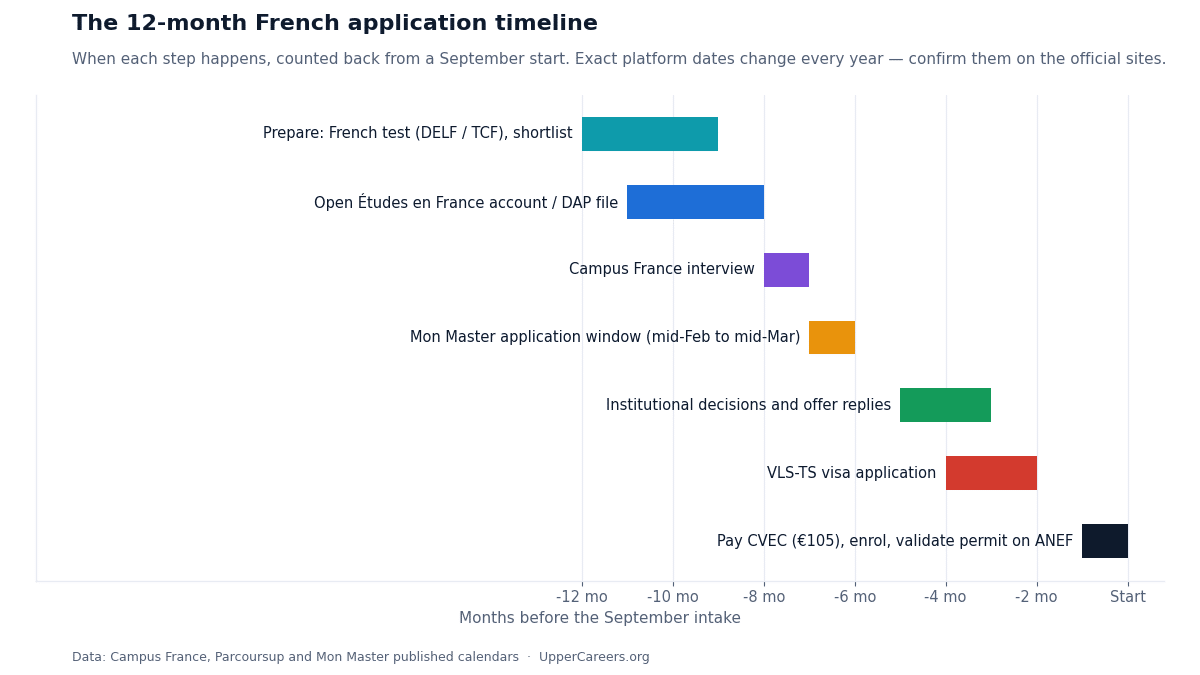
- Create your Études en France account.Open the file on your Campus France country website, ideally in the autumn before the September intake you are targeting.
- Build your academic file.Upload transcripts, diplomas, certified translations, your CV, a motivation letter for each choice, and your language certificate — DELF/DALF, TCF or TEF for French-taught programmes, IELTS or TOEFL for English-taught ones.
- Choose your programmes and pay the procedure fee.The number of choices and the fee are set by your country’s Campus France office.
- Attend the Campus France interview.A short discussion of your study project: why this programme, why France, how it fits your career, and how you will fund it.
- Wait for institutional decisions.Institutions publish their responses through the platform; timing varies by level and by country.
- Accept one offer and move to the visa stage.Campus France transmits the validated file to the consulate; you book the visa appointment and attend with the full document set.
- Pay the CVEC and enrol.The €105 contribution is paid online, and the certificate is required before the institution can register you.
- Arrive and validate your VLS-TS online.Within three months of arrival, on the government’s ANEF portal.
The interview, in detail
The Campus France interview is short and is not a test of your knowledge. It tests coherence. Advisers are checking that the programme you have chosen follows logically from what you have already studied, that you understand what the course involves, that your funding plan is real, and that you can explain your intentions in the language of instruction.
Prepare by being able to answer four questions in two sentences each: why this subject, why this specific programme, why France rather than elsewhere, and what you intend to do afterwards. Vague answers about the quality of French education are the most common weakness.
Documents that cause delays
- Translations that are not certified. Budget time and money for a sworn translator.
- Transcripts that do not match the diploma. Names, dates of award and marks must be consistent across documents.
- Missing intermediate qualifications. Upload the full chain, not only the highest degree.
- Language certificates that expire. Test scores are valid for a limited period; diplomas are not.
Three mistakes that cost applicants a year
- Starting in early summer for a September intake. The academic stage alone runs for months.
- Leaving language proof until last. Test sessions fill up and results take weeks.
- An incoherent study project. The interview exists to test exactly this.
The Tuition Reform, Explained
A recent government decree made differentiated tuition fees the rule for non-EU students and tightly limited the waivers universities may grant. The published rates are €2,902 for a Licence, €3,950 for a Master’s, and €398 for a doctorate.
| Level | EU / EEA / Swiss | Non-EU |
|---|---|---|
| Licence | €178 | €2,902 |
| Master | €255 | €3,950 |
| Doctorate | €397 | €398 — differentiated fees do not apply |
What changed, in practice
Under the previous arrangement, universities were encouraged but not obliged to charge the higher rates, and most chose to waive them so that international students paid the same as everyone else. The new rule reverses that default: the higher fees now apply unless a specific exemption exists, and institutional discretion has been narrowed sharply. The government has indicated that fee waivers will reach only a small minority of students.
Who is exempt from the higher rate?
- Residents of Québec
- Holders of a long-term resident permit, and students attached to a French tax household for more than two years
- Refugees and beneficiaries of subsidiary protection, and their children
- Doctoral candidates, HDR candidates, and third-cycle medical, dental and pharmacy students
- Students in a classe préparatoire who are simultaneously enrolled in a university Licence
And who gets a full waiver?
Automatic full waivers go to holders of a French government scholarship and to students arriving under agreements providing for reciprocal waivers. Institutions may still grant waivers case by case — for students from countries in crisis, refugees, students with disabilities, or serious financial hardship — but the scope is far narrower than before.
Transitional protection applies. Students who already held a waiver, or who were granted one before the decree took effect, keep it for the rest of their current degree cycle provided they stay at the same institution.
Does this change the value of studying in France?
It raises the cost, but the comparison still favours France. €3,950 for a Master’s at a public institution remains a fraction of what an equivalent degree costs in the United Kingdom, the United States or Australia, the state continues to fund roughly two-thirds of the real cost of every place, and doctoral study is untouched by the reform.
Visa and VLS-TS Validation
What is a VLS-TS?
The visa de long séjour valant titre de séjour is a long-stay visa that becomes your residence permit once you validate it online after arrival. It is the standard permit for non-EU students staying longer than six months.
What the consulate wants to see
- Your admission and, for EEF countries, the completed Études en France file
- Proof of financial resources — a minimum of €615 per month, per Campus France
- Accommodation arrangements, at least for your first months
- Health cover, and a valid passport with sufficient remaining validity
The step most students forget
Validation. Within three months of arriving you must validate the VLS-TS through the ANEF portal run by the Ministry of the Interior, and pay the residence tax stamp. Without validation you cannot renew your permit, cannot re-enter France after travelling outside the Schengen area, and will meet obstacles opening accounts or claiming housing assistance — even though your visa sticker looks perfectly valid.
Renewing your permit
Renewal is done through the same ANEF portal, and you should begin several months before expiry. Prefectures are busy, appointments are not always immediate, and a lapsed permit is far harder to fix than one renewed in good time.
Budget and Proof of Funds
How much do I need to show?
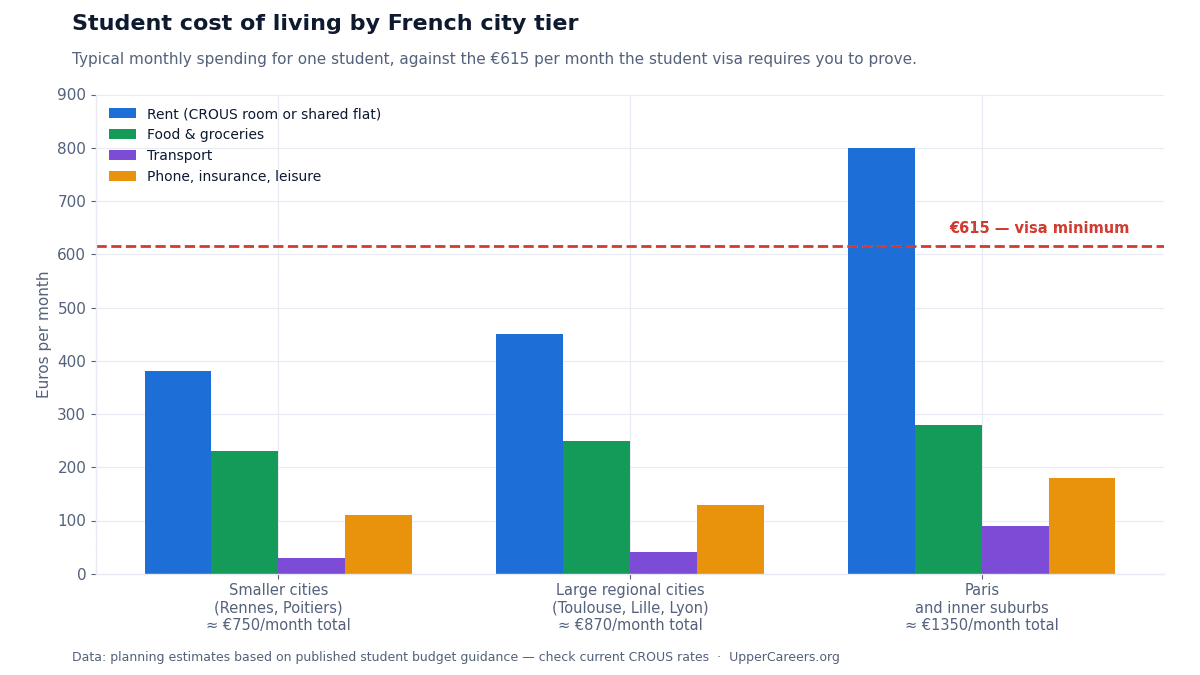
Campus France states a minimum of €615 per month for the duration of your stay — about €6,150 for a ten-month academic year — evidenced with bank statements, a scholarship certificate, or a sponsor’s formal guarantee.
Is €615 enough to live on?
It is the administrative minimum, not a realistic budget everywhere. Outside the capital, students in cities such as Toulouse, Lille or Rennes commonly manage on €750 to €900 a month including CROUS accommodation. In Paris, rent alone frequently exceeds the entire minimum.
What proof consulates accept
- Personal or family bank statements covering several months of history
- A scholarship award letter stating the amount and duration
- A formal guarantee from a sponsor, supported by their own financial documents
- In some countries, a blocked account arranged through a bank
A single large deposit made shortly before the appointment invites questions. What is being assessed is whether the money is genuinely available to you for the whole year, not whether a balance existed on one particular day.
What else the budget must cover
Beyond rent and food: the €105 CVEC, your tuition, the visa fee, complementary health insurance, a deposit and first month’s rent on arrival, document translation, and travel. Students may work up to 964 hours a year and typically cover a meaningful share of living costs that way — but no consulate accepts future earnings as proof of funds.
Official Websites for the Application Process
Every step above has one authoritative website. Fees and deadlines on third-party sites are frequently out of date.
| Website | Run by | What you will find there |
|---|---|---|
| Études en France | Ministry for Europe and Foreign Affairs, operated by Campus France | The platform where non-EU applicants in covered countries build their academic file, choose programmes, book the Campus France interview, and have their file forwarded to the consulate. |
| Campus France | National agency for higher education promotion (Ministries of Europe and Foreign Affairs, and of Higher Education) | The central portal for international students: the programme catalogue, current tuition figures, scholarship pages, visa explanations, and the network of Campus France offices in your own country. |
| France-Visas | Ministry for Europe and Foreign Affairs | The official visa portal: a wizard that tells you which visa you need, the exact document list for your nationality, current fees, and where to submit your application. |
| ANEF — administration-etrangers-en-france | Ministry of the Interior | Where you validate your VLS-TS within three months of arriving, and later renew your residence permit. Skipping this step is the most common administrative mistake students make. |
| CVEC portal | CROUS, for the Ministry of Higher Education, Research and Space | Where you pay the €105 Student and Campus Life Contribution for the academic year and download the certificate your institution needs before it can enrol you. |
| enseignementsup-recherche.gouv.fr | Ministry of Higher Education, Research and Space | The source of the tuition decrees themselves, including the official FAQ on differentiated fees for non-EU students and the list of recognised institutions. |
Every site above is run by a French ministry, a public agency, or a publicly funded body. Where these sites and this guide ever differ, the official site is right.
Frequently Asked Questions
What is the Études en France procedure?
Who does not have to use Études en France?
When should I start the Campus France procedure?
What happens at the Campus France interview?
How much money must I show for the French student visa?
What is VLS-TS validation and why does it matter?
Who is exempt from the differentiated tuition fees?
Accuracy note: French tuition, visa and residence rules changed significantly in the most recent reform and can change again. The figures in this guide — tuition of €2,902, €3,950 and €398, the €105 CVEC, the €615 monthly proof of funds, the 964-hour work limit and the €2,300 doctoral contract — were checked against Campus France and French government sources when this article was last updated. Always confirm the current rules on the official Campus France, ministry, or France-Visas page before you act. Nothing here is a guarantee of admission, funding, or a visa.