
GPA Converter: Percentage & CGPA to Any Country’s Scale
💡 How To Use This Well
- Take the minimum passing grade from your own university’s examination regulations, not from a general country average — it changes the result more than any other input.
- Use your cumulative grade across the whole degree, not a single semester, since that is what admissions offices assess.
- If your transcript reports both a percentage and a CGPA, convert both and quote the one your target university asks for.
- Where a university states its own conversion rule, that rule always overrides any calculator, including this one.
⚠️ Where Conversions Go Wrong
- Credential evaluators such as WES and ECE apply their own band tables, so their figure can differ from any formula-based result.
- Top marks are awarded very differently across countries. A mapped UK 78% or French 17/20 signals a strong result, not a mark you would literally receive.
- Multiplying your percentage by four is a common shortcut and a misleading one, because it ignores where the pass mark sits.
- Medicine, law and teacher-training programmes frequently use separate scales that general converters do not model.
📋 Disclaimer
This converter is provided for guidance and orientation only and produces a non-binding estimate. It is not an official credential evaluation and carries no admissions weight. Only the admitting university, its examination office, or an accredited credential evaluation service can issue a binding conversion of your grades. Always confirm requirements with the institution you are applying to before relying on any figure shown here.
📐 The Formulas Behind This Converter
1. Modified Bavarian Formula — the German grade
2. Pass-band position — how every other system is derived
3. Credit-weighted grade — combining individual courses
4. UK honours classification bands
A grade of 75 can be outstanding in one country and ordinary in another, because every national system places its pass mark and its top grade in a different spot. This guide explains how grade conversion actually works, walks through the Modified Bavarian Formula that German universities use, shows the same result mapped across the major national scales, and explains how to use the UpperCareers GPA Converter. It is written for students and early-career researchers — factual information only.
Why the same result means different things in different countries
Imagine two students. One finishes an Indian bachelor’s degree with an aggregate of 75 per cent. The other finishes a British degree with 75 per cent. On paper the numbers are identical. In practice they describe very different achievements, because the two systems are built on different foundations.
Two things change from country to country, and both matter:
- The minimum passing grade — the floor a student must clear to be awarded credit at all.
- The highest grade obtainable — the ceiling, which in some systems is realistically reachable and in others almost never awarded.
Move either of those and the meaning of every number in between shifts with it. An Indian degree with a pass mark of 35 gives a student sixty-five points of room above the floor. A Dutch degree with a pass mark of 5.5 on a scale to 10 gives four and a half. The same raw distance above the pass mark therefore represents a completely different level of achievement.
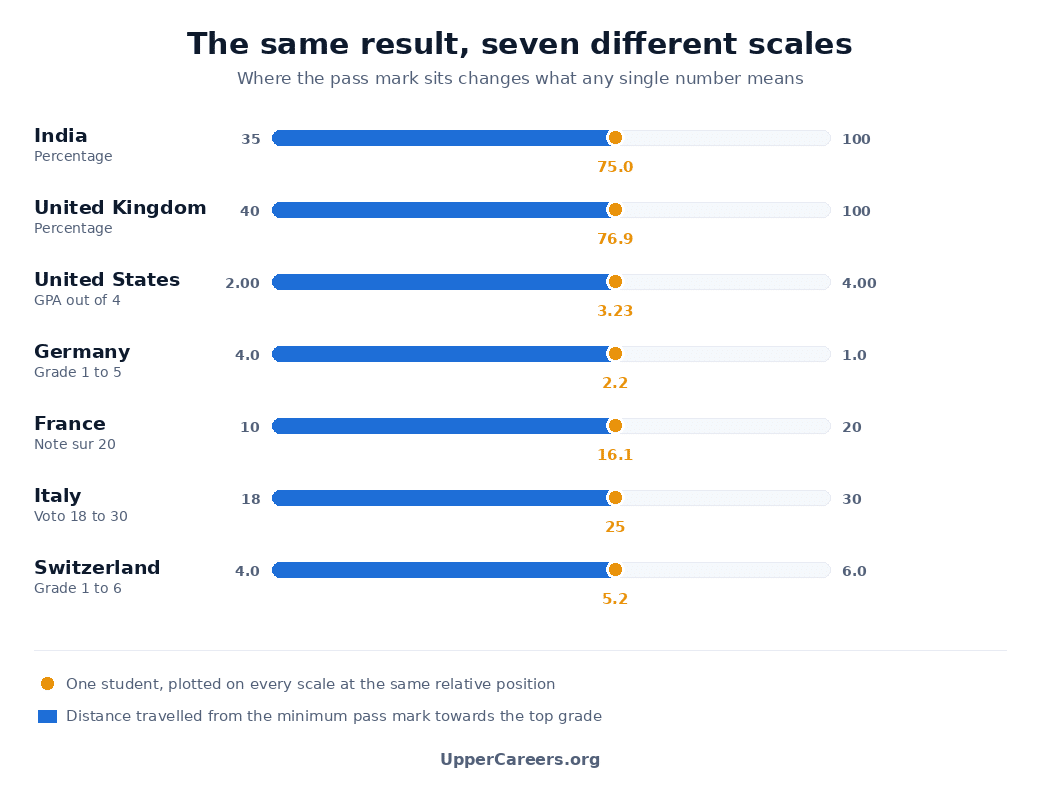
Pass marks and top grades across ten systems
The table below shows the commonly applied minimum pass mark and the highest grade in ten widely used systems. Treat these as the typical national pattern, not as a universal rule — individual universities set their own thresholds in their examination regulations, and a few disciplines use separate scales entirely.
| Country or system | Scale | Minimum pass | Best grade |
|---|---|---|---|
| India | Percentage | Commonly 35 to 40 | 100 |
| United Kingdom | Percentage | 40 | 100 |
| United States | GPA out of 4.0 | Commonly 2.00 for good standing | 4.00 |
| Germany | Grade 1.0 to 5.0 | 4.0 | 1.0 |
| France | Note out of 20 | 10 | 20 |
| Italy | Voto out of 30 | 18 | 30 |
| Netherlands | Cijfer 1 to 10 | 5.5 | 10 |
| Switzerland | Grade 1 to 6 | 4.0 | 6.0 |
| Australia | 7-point scale | 4.0 | 7.0 |
| China | Percentage | Commonly 60 | 100 |
Notice Germany and Switzerland. Both label their grades with small whole numbers, but they run in opposite directions: the best German grade is 1.0 and the best Swiss grade is 6.0. Reading a Swiss transcript as though it were German turns an excellent result into a failing one.
Why multiplying your percentage by four does not work
The most common shortcut on the internet is to divide a percentage by 25, or equivalently multiply it by 0.04, to produce a figure out of four. It is quick, and it is wrong, because it silently assumes that zero on your scale means the same thing as zero on the American one.
Take the Indian student with 75 per cent. The shortcut gives 75 × 0.04 = 3.0. But that student cleared a pass mark of 35 and sits well into the upper part of the usable range. A method that accounts for the pass floor places the same student closer to 3.2.
Now take a Chinese student, also with 75, but on a scale where the pass mark is 60. The shortcut returns 3.0 again — the identical figure — even though this student has covered under two fifths of the ground available above their pass mark. Accounting for the floor places them nearer 2.8. The shortcut collapses two different achievements into one number, and it errs in opposite directions: it understates results from systems with a low pass mark and overstates results from systems with a high one.
The shortcut also collapses entirely on scales that do not begin at zero. An Italian mark runs from 18 to 30. Multiply 24 out of 30 by the same logic and the answer is meaningless, because 17 out of 30 is not a low pass in Italy — it does not exist as a recorded grade at all.
Who actually needs a converted grade
- Master’s applicants, because most programmes publish a minimum entry grade in their own national terms and expect you to show that you meet it.
- PhD applicants, where a converted grade is often the first filter applied before anyone reads a research proposal.
- Scholarship applicants, since many funding bodies set a numerical threshold and apply it consistently across all countries of origin.
- Anyone facing credential evaluation, who wants a rough idea of the outcome before paying for an official assessment.
How the Modified Bavarian Formula converts any scale into a German grade
Germany faced this problem earlier and more often than most countries, and settled on a single arithmetic rule rather than a long table of country-by-country equivalents. That rule is the Modified Bavarian Formula. The Technical University of Munich states plainly that converted grades are calculated using this formula, as set out in a resolution of the Kultusministerkonferenz, the standing conference of German education ministries.
The formula is short:
x = 1 + 3 × (Nmax − Nd) ÷ (Nmax − Nmin)
- x is your grade in the German system, where 1.0 is the best grade and 4.0 the minimum pass.
- Nmax is the best grade obtainable at your university.
- Nmin is the minimum passing grade at your university.
- Nd is the overall grade you actually earned.
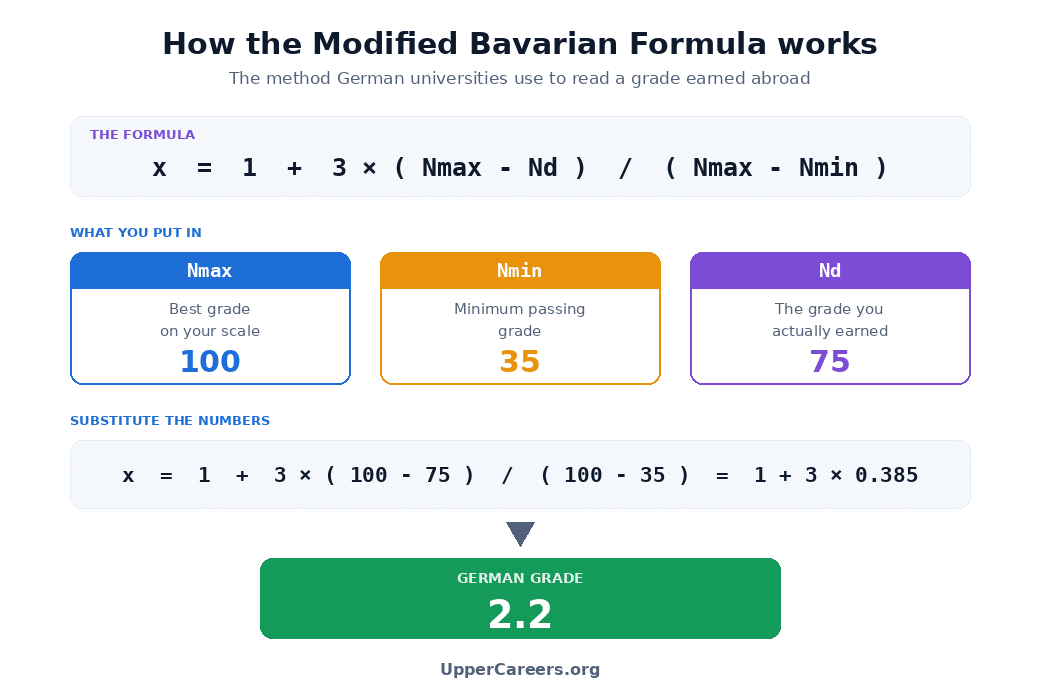
A worked example, step by step
Take an Indian bachelor’s degree with an aggregate of 75, a pass mark of 35, and a maximum of 100.
- Find the gap between the top grade and your grade: 100 − 75 = 25.
- Find the full usable range: 100 − 35 = 65.
- Divide one by the other: 25 ÷ 65 = 0.385.
- Multiply by three: 0.385 × 3 = 1.15.
- Add one: 1 + 1.15 = 2.2.
The result, a German 2.2, sits in the gut band. That is a fair reading: the student is clearly above average but not at the very top of their cohort.
The same arithmetic in reverse
The formula also explains what a German grade means elsewhere. A German 2.0 is exactly one third of the way down from the top of the pass band, since the band runs from 1.0 to 4.0 and 2.0 sits one point below the ceiling. That student has covered two thirds of the distance from a bare pass to a perfect result. Applied to an Indian scale with a pass mark of 35, two thirds of the way up gives roughly 78. Applied to a French scale, it gives roughly 16.7 out of 20.
Four conversions side by side
| Starting grade | Best grade | Pass mark | German result | German band |
|---|---|---|---|---|
| 75 out of 100 (India) | 100 | 35 | 2.2 | Gut |
| 8.2 CGPA out of 10 (India) | 10 | 4.0 | 1.9 | Gut |
| 68 per cent (United Kingdom) | 100 | 40 | 2.6 | Befriedigend |
| 27 out of 30 (Italy) | 30 | 18 | 1.8 | Gut |
Look at the second and fourth rows. An Indian CGPA of 8.2 and an Italian 27 out of 30 land within a tenth of each other, even though the raw numbers share nothing in common. That is the point of the formula: it compares positions within a system rather than digits across systems.
Where the formula needs care
- Reversed scales. If the best grade is the lowest number, as in Germany itself, enter the best grade as your Nmax even though it is numerically smaller. The arithmetic handles the reversal correctly on its own.
- Scales without a real pass floor. A few systems report only a letter or a pass or fail decision. The formula needs a numerical minimum, so you will have to take one from your examination regulations first.
- Grades below the pass mark. The formula is defined for results that passed. A failing grade produces a figure outside the 1.0 to 4.0 band, which no German office will accept.
- Guessed inputs. The pass mark is the single most influential number in the calculation. Guessing it wrongly by five points can move the German result by a full tenth or more.
Converting into the US 4.0 GPA, UK classifications and other national scales
The Bavarian Formula answers one question: what is my grade in Germany? The same underlying idea answers every other version of the question too, once you separate the method from the German numbers attached to it.
The one number that travels between systems
Strip the formula back and it is measuring a single thing: how far you sit between a bare pass and the top grade. Call that position q.
q = (Nd − Nmin) ÷ (Nmax − Nmin)
A student who scraped a pass has a q of zero. A student with a perfect result has a q of one. Our Indian student with 75 has a q of 0.615, meaning they have covered just over three fifths of the available ground.
Because q carries no national units, it can be poured into any other system by reading it against that system’s own pass mark and ceiling:
result = pass mark of target system + q × (top grade − pass mark)
On the American scale, which runs from 2.00 for good standing to 4.00 at the top, that gives 2.00 + 0.615 × 2.00 = 3.23.
One result, twelve systems
Here is the same student — an Indian aggregate of 75 with a pass mark of 35 — expressed everywhere at once.
| Country or system | Scale | Equivalent | Typical band |
|---|---|---|---|
| United States | GPA out of 4.00 | 3.23 | B / Good |
| Canada | GPA out of 4.33 | 3.43 | A minus |
| Germany | 1.0 best to 4.0 pass | 2.2 | Gut |
| United Kingdom | Percentage | 77 | First |
| Australia | 7-point scale | 5.8 | Distinction |
| France | Note out of 20 | 16.2 | Très bien |
| Netherlands | Cijfer 1 to 10 | 8.3 | Zeer goed |
| Italy | Voto 18 to 30 | 25 | Buono |
| Spain | Nota 0 to 10 | 8.1 | Notable |
| Switzerland | Grade 1 to 6 | 5.2 | Gut |
| China | Percentage | 85 | Very good |
| India | CGPA out of 10 | 7.69 | First class |
UK classifications and why the Upper Second matters
British degrees are reported as an honours classification rather than a bare number. The bands are fixed and widely used:
| Percentage | Classification | Short form |
|---|---|---|
| 70 and above | First Class Honours | First |
| 60 to 69 | Upper Second Class Honours | 2:1 |
| 50 to 59 | Lower Second Class Honours | 2:2 |
| 40 to 49 | Third Class Honours | Third |
The 2:1 boundary is the one that changes outcomes. A large share of taught master’s programmes in the United Kingdom, and most competitive funded routes, set an Upper Second as their entry floor. If your converted result lands at 59 or 61 it is worth checking your inputs carefully, because a single point either side of that line has real consequences.
Combining individual courses first
Most transcripts list a grade for every course rather than one overall figure. Averaging them by hand without weighting is a common and costly mistake, because courses do not carry equal weight.
G = Σ(grade × credits) ÷ Σcredits
Take three courses: 78 over four credits, 66 over two credits, and 90 over two credits. The weighted average is (312 + 132 + 180) ÷ 8 = 78.0, which here happens to match the simple average of the three grades. Now reverse the credits so the weakest course, the 66, carries four credits while the 78 and the 90 carry two each. The weighted average falls to (156 + 264 + 180) ÷ 8 = 75.0, while the simple average sits unchanged at 78.0. Whenever your weakest results sit in your heaviest courses, weighting matters — and it always moves the number in the direction you would rather it did not.
Two honest limits
- Credential evaluators use their own tables. Services such as WES and ECE assess transcripts against internal band tables built from their own country research. Their figure can differ from any formula-based result, in either direction. If an institution requires an evaluation from a named service, that service’s number is the one that counts.
- Top-of-scale marks are often unreachable. British examiners rarely award marks above the low eighties, and French examiners rarely go beyond 17 out of 20. A mapped UK 77 or a French 16.2 should be read as a signal of a strong result, not as a mark you would literally have received had you studied there.
How to use the UpperCareers GPA Converter step by step
The converter applies everything above automatically. It is free, needs no account, and returns a result as you type.
1 · Select your grading system
Pick the system your transcript uses from the dropdown. Choosing a preset fills in the scale bounds, the typical pass mark and the correct decimal precision, so you are not starting from a blank form. If your scale is unusual, choose the custom option and enter the numbers yourself.
2 · Enter your overall grade
Type your cumulative result, or drag the slider. Use the grade for your whole degree rather than a single semester, because that is the figure admissions offices assess.
3 · Confirm the best grade and the pass mark
This is the step most people rush, and the one that changes the answer most. Open your university’s examination regulations and take both numbers from there. A pass mark of 35 and a pass mark of 40 look almost identical on the page and produce visibly different results. Remember that on a reversed scale the best grade is the smaller number.
4 · Choose the headline result
Select which system you want displayed in the large panel — the American 4.0 GPA, the German grade, a British percentage with its classification, a normalised percentage, the Canadian 4.33 scale, or the Australian 7-point scale. The other results stay visible below it.
5 · Read the cross-system table
Below the calculator, your result appears in every major national scale at once, each with the band it falls into. This is the fastest way to sanity-check a figure: if one row looks obviously wrong for your situation, an input is usually wrong rather than the arithmetic.
6 · Use the credit-weighted calculator first, if you need to
If your transcript lists courses individually, work out the overall figure in the credit-weighted section before converting. Enter each course with its credits and its grade, then send the weighted result straight up into the converter.
What each result field tells you
| Field | What it shows | What to do with it |
|---|---|---|
| Headline result | Your grade in the system you selected | Quote it on applications to that country, alongside your original grade |
| US GPA | Your position mapped onto the 4.0 scale | Compare against a programme’s stated minimum GPA |
| German grade | The Modified Bavarian Formula result | Check against German entry requirements, which are usually stated as a grade |
| UK classification | The honours band your result falls into | Confirm whether you clear the Upper Second threshold |
| Your standing | How far you sit between a bare pass and the top grade | Use it to understand why a number differs from what you expected |
| Cross-system table | The same result in every major scale | Prepare a single figure for each country you are applying to |
Mistakes that produce a wrong answer
- Using a semester grade. A strong final semester does not represent the degree, and admissions offices will notice the difference against your transcript.
- Guessing the pass mark. Country averages found online are frequently wrong for a specific university. Use your own regulations.
- Averaging courses without credits. An unweighted average flatters a transcript whenever the weakest results sit in the heaviest courses.
- Reading a reversed scale forwards. Entering a Swiss 5.2 as though the best grade were 1.0 turns a good result into a poor one.
- Treating the output as official. A converted grade supports your application; it never replaces your transcript.
The converter is a guidance tool. It is not a credential evaluation, carries no admissions weight, and cannot bind any institution. Where a university publishes its own conversion rule, that rule always overrides any calculator, including this one.
Where to verify your converted grade
Every source below is a government body, a publicly funded agency, or a public university. Use them to confirm anything a calculator tells you.
Germany
- Technical University of Munich — grade conversion
The official explanation of the Modified Bavarian Formula together with a conversion tool, published by a public German university. It states clearly that results are non-binding and that each degree programme’s examination regulations govern the official conversion.
tum.de - Kultusministerkonferenz
The standing conference of German education ministries, whose resolution establishes the conversion method used across German higher education. This is the source document behind every German university’s conversion practice.
kmk.org - Anabin
The publicly maintained German database of foreign qualifications and institutions. It records how a degree from a given country and university is classified in Germany, which matters as much as the grade itself.
anabin.kmk.org - uni-assist
The shared application service used by many German universities for international applicants. It checks documents and converts grades on behalf of member institutions, so its assessment is the operative one for programmes that use it.
uni-assist.de - DAAD
The German Academic Exchange Service, publicly funded, with guidance on admission requirements and funding for international students and researchers.
daad.de
United Kingdom
- UK ENIC
The official United Kingdom organisation for the recognition and comparison of international qualifications, working with the Department for Education and managed by Ecctis. It issues statements of comparability that British universities and employers accept.
enic.org.uk
Europe and beyond
- ENIC-NARIC network
The joint network of national recognition centres established under the Lisbon Recognition Convention. It lists the official recognition agency for each participating country, which is the correct starting point wherever you are applying.
enic-naric.net - Your own university’s examination regulations
Not a website but the most important source in this list. Your pass mark, your maximum grade and the rules for calculating your overall result are all defined there, and every conversion depends on them.
Policies, thresholds and services change over time. Always open the official page for the country and institution you are applying to rather than relying on a summary, including this one.
Frequently asked questions
What GPA is a 75 per cent from an Indian university?
On a scale where the pass mark is 35 and the maximum is 100, an aggregate of 75 places you about 61 per cent of the way between a bare pass and a perfect result. Mapped onto the American scale that is roughly 3.2 out of 4.0, and mapped onto the German scale it is roughly 2.2. If your university uses a pass mark of 40 rather than 35, the same 75 gives a slightly lower figure, which is why you should take the pass mark from your own examination regulations rather than a general country average.
How do I convert my CGPA out of 10 into a 4.0 GPA?
Do not simply divide by 2.5. Use the pass mark of your own scale. If your minimum passing CGPA is 4.0 and the maximum is 10, a CGPA of 8.2 sits 70 per cent of the way up the usable range, which maps to about 3.4 on the American scale. Dividing 8.2 by 2.5 gives 3.28, which looks close enough here, but the two methods pull apart lower down: at a CGPA of 6 the shortcut gives 2.40 against a pass-aware 2.67.
Is multiplying my percentage by 0.04 a valid way to get my GPA?
No, and it is the most common error in grade conversion. That shortcut assumes zero on your scale means the same as zero on the American one, which ignores the pass mark entirely. It understates results from systems with a low pass mark, such as India, and overstates results from systems with a high pass mark, such as China. It also produces meaningless answers for scales that do not start at zero, such as the Italian 18 to 30 scale. Use a method that accounts for both the pass mark and the maximum grade.
What is the Modified Bavarian Formula?
It is the arithmetic rule German universities use to express a grade earned abroad in German terms. It measures how far your grade sits between your university’s minimum pass mark and its best obtainable grade, then places you at the same relative position on the German scale, which runs from 1.0 at the top to 4.0 at the minimum pass. The Technical University of Munich publishes it as the method stipulated by the resolution of the Kultusministerkonferenz.
Which grade counts, my final year or my whole degree?
Use the cumulative result for the whole degree unless a programme explicitly asks for something else. Some universities do ask for the final two years only, and a few weight the final year more heavily, but these are exceptions stated in the admission requirements. Converting a single strong semester and presenting it as your degree result will not survive comparison with your transcript.
Do German universities accept a converted grade from an online calculator?
No. A calculator gives you an estimate for planning purposes. The binding conversion is performed by the admitting university, by its examination office, or by uni-assist where the university uses that service. The Technical University of Munich states directly that its own conversion results are non-binding and that the examination regulations of each degree programme govern the official figure.
What UK classification does my grade correspond to?
British honours classifications follow fixed bands: 70 and above is a First, 60 to 69 is an Upper Second or 2:1, 50 to 59 is a Lower Second or 2:2, and 40 to 49 is a Third. Convert your grade into a British percentage first, then read the band. The 2:1 boundary is the one to watch, since most competitive and funded postgraduate routes in the United Kingdom set it as their entry floor.
Do I still need WES or ECE if I have converted my grade myself?
Yes, if the institution asks for it. A credential evaluation from a named service is a formal document produced from your verified transcript, and self-conversion cannot substitute for it. Those services also apply their own band tables, so their figure may differ from a formula-based estimate. Convert your grade yourself to plan and to check you meet a threshold, then order the evaluation the institution actually requires.
Educational and informational content only. UpperCareers does not process admissions, does not carry out credential evaluations, and is not affiliated with the institutions or agencies listed. Grading scales, pass marks, entry requirements and recognition procedures differ between universities and change over time, and this page may contain errors; always verify with your own examination regulations and with the official website of the institution you are applying to before relying on any converted grade.