
ECTS Calculator: Convert ECTS to US, UK, and Other Credits
💡 How To Use This Well
- For a study-abroad or transfer application, quote the credits your home institution awarded and let the receiving university convert. This tool tells you what to expect, not what to claim.
- Check the total your target degree requires. German and Dutch master’s programmes commonly ask for 240 ECTS at bachelor level, which a three-year 180 ECTS degree does not meet on its own.
- If your transcript states the hours behind each module, use the workload calculator rather than the credit converter. Hours are the thing ECTS is actually defined on.
- Where a university publishes its own conversion table, use its numbers rather than these.
⚠️ Where Conversions Go Wrong
- Credit conversion is not grade conversion. Credits measure how much you studied; grades measure how well. They transfer under separate rules.
- Universities transfer credit course by course, not in bulk. A total that converts neatly can still lose credits when individual modules do not match the receiving programme.
- Australian practice varies more than any other system here. EFTSL is national, but the credit-point systems layered on top of it differ between universities, so always check the local figure.
- Converting by raw hours instead of by degree proportion inflates non-European credits. See the method section below for why the two disagree.
📋 Disclaimer
This calculator is provided for guidance and planning only and produces a non-binding estimate. It is not an official credit transfer assessment and carries no academic weight. Only the receiving institution can decide how much credit to award, and it does so module by module against its own programme. Always confirm with the university you are applying to before relying on any figure shown here.
📐 How This Calculator Works
1. Everything converts through a fraction of a full-time year
2. Why converting by raw hours gives a different answer
3. Turning workload into ECTS
4. The credit systems used here
5. Sources
US credit hour: the federal definition in the Code of Federal Regulations, explained by the US Department of Education.
UK credit: the Higher Education Credit Framework for England published by the QAA.
A semester abroad, a transfer application, or a master’s programme asking for 240 credits — all of them need your study converted into a system you did not study under. This guide explains what ECTS credits are, how they convert into US credit hours, UK credits and other national systems, why two common conversion methods give different answers, and how to work out the ECTS value of a course from its workload. It is written for students and early-career researchers — factual information only.
What ECTS credits are, and why they need converting
ECTS stands for the European Credit Transfer and Accumulation System. It is the shared unit European universities use to describe how much study a course involves, and it exists so that a semester completed in one country can be recognised in another without anyone having to guess.
The rule at the centre of it is simple. A full-time academic year is worth 60 ECTS credits, which means a semester is normally 30. Everything else follows from that.
Credits measure time, not marks
This is the point most people miss, and it causes real confusion. An ECTS credit says nothing about how well you did. It describes the workload a course demands — the notional time an average student needs in order to reach the learning outcomes. Your grade and your credits travel together on a transcript but are assessed under completely separate rules.
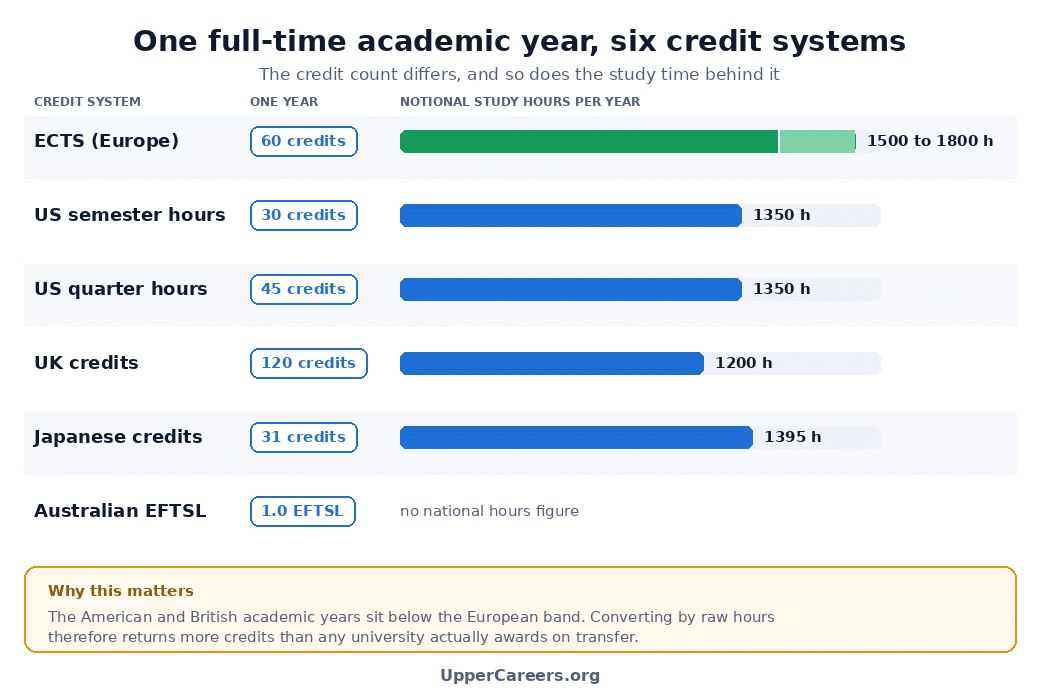
One ECTS credit is defined as 25 to 30 hours of total student workload. That total is not just time in a lecture theatre. It covers seminars, practical and laboratory work, private reading, assignments, and revision for examinations. A full-time year therefore represents somewhere between 1,500 and 1,800 hours of study.
Why the range is 25 to 30 rather than a single number
Each country, and sometimes each university, fixes its own figure within that band. Some set 25 hours per credit, others 30. The European framework deliberately leaves room for this, because teaching patterns and term lengths differ across the continent. If your institution publishes its own figure, use it rather than an average.
One consequence worth understanding: because the figure is a range, the same 6 ECTS module can represent 150 hours at one university and 180 at another. Neither is wrong. This is why credit transfer is decided module by module rather than by a single conversion rate.
How many credits a degree needs
| Qualification | Typical ECTS | Full-time length |
|---|---|---|
| One semester | 30 | Half a year |
| One academic year | 60 | One year |
| Bachelor’s degree | 180 or 240 | Three or four years |
| Master’s degree | 60, 90 or 120 | One to two years |
The bachelor’s row matters more than it looks. A three-year degree of 180 ECTS and a four-year degree of 240 ECTS are both perfectly normal, but some master’s programmes in Germany and the Netherlands require 240 at entry. A graduate of a three-year programme can meet every academic requirement and still fall short on credit volume alone. If you are applying to those countries, check the credit requirement before anything else.
Who needs a conversion
- Exchange and Erasmus students, who must show that a semester abroad carries enough credit to count at home.
- Transfer students, moving between systems mid-degree and needing to know what carries over.
- Master’s applicants, checking whether their bachelor’s degree meets a credit threshold.
- Course designers, who need to assign an ECTS value to a module they are building.
Converting ECTS into US, UK and other credit systems
Every credit system in this guide defines a full-time academic year. That shared anchor is what makes conversion possible: express your credits as a fraction of a year, then read that fraction against the target system.
year fraction = your credits ÷ credits per full-time year
target credits = year fraction × target system’s credits per year
The rules of thumb, and where they come from
Applying that method to the standard year lengths produces the ratios you will see quoted everywhere:
- 2 ECTS = 1 US semester credit hour, because 60 ECTS and 30 semester hours are both one year.
- 1 ECTS = 2 UK credits, because 60 ECTS and 120 UK credits are both one year.
- 4 UK credits = 1 US semester credit hour, which follows from the two above.
- 3 US quarter hours = 2 US semester hours, since a quarter year is shorter than a semester.
These are not arbitrary conventions. They fall out of the arithmetic once you know how each system defines a year.
What a full-time year looks like in each system
| System | Credits per full-time year | Hours per credit | Hours per year |
|---|---|---|---|
| ECTS (Europe) | 60 | 25 to 30 | 1,500 to 1,800 |
| US semester credit hours | 30 | About 45 | About 1,350 |
| US quarter credit hours | 45 | About 30 | About 1,350 |
| UK credits (CATS and SCQF) | 120 | 10 | 1,200 |
| Canadian credits (semester) | 30 | About 45 | About 1,350 |
| Japanese credits | About 31 | About 45 | About 1,395 |
| Australian EFTSL | 1.0 | Not defined nationally | Not defined nationally |
Look down the last column. The three systems do not agree on how many hours a year contains, and that disagreement is the source of a great deal of bad advice online.
Two methods, two different answers
There are two ways you could convert credits, and they do not produce the same result.
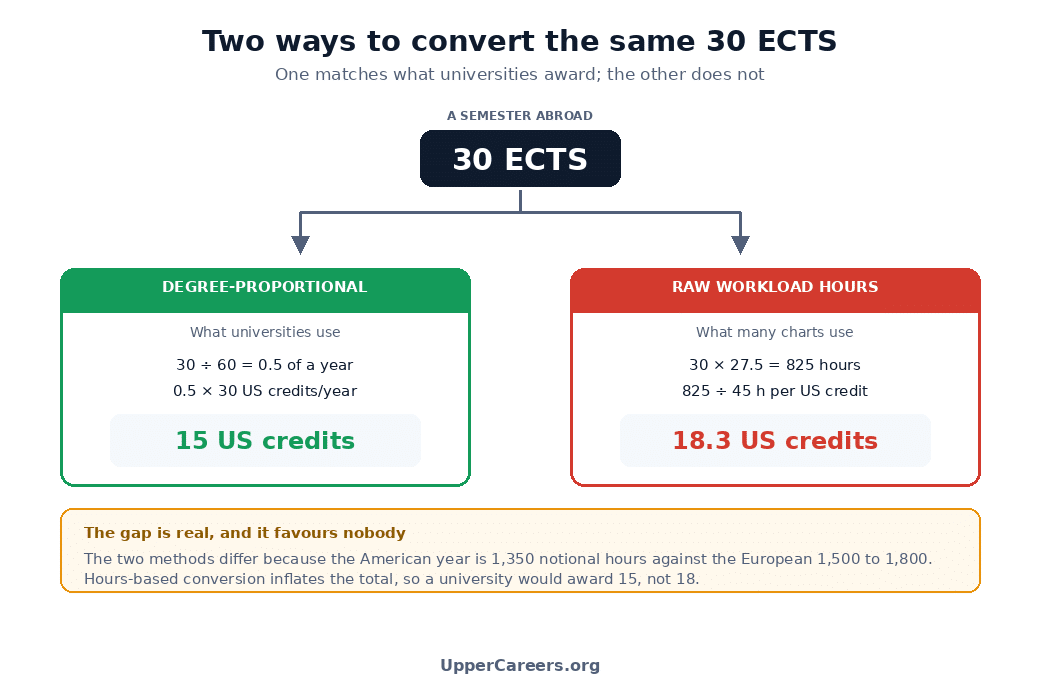
Degree-proportional treats your credits as a share of an academic year. Thirty ECTS is half a European year, so it becomes half an American year: 15 semester credit hours.
Raw workload hours converts the study time instead. Thirty ECTS at 27.5 hours per credit is 825 hours; divided by the roughly 45 hours behind one US credit, that gives 18.3.
The second figure is larger because the nominal American year contains fewer hours than the European one. Dividing European workload by American hours-per-credit therefore hands out credits no university would grant. Institutions use the degree-proportional method, and so does the UpperCareers calculator.
This is worth checking whenever you find a conversion figure online. If a chart tells you 30 ECTS is worth 18 US credits, it has divided hours by hours and produced a number that will not survive contact with an admissions office.
A worked example
Lena finishes a Dutch bachelor’s degree worth 180 ECTS and applies to programmes in three countries. Her 180 ECTS is three full-time years, so it converts to 90 US semester credit hours, 360 UK credits and 3.0 EFTSL in Australia. Her workload behind those credits is roughly 4,950 hours at 27.5 hours per credit.
One thing that number does not tell her: whether a specific American university will accept all 90. Credit is transferred module by module against the receiving programme’s own requirements, and a total that converts cleanly can still lose credits where individual courses do not match.
Working out the ECTS value of a course from its workload
Credit conversion answers one question. A different one comes up just as often: how many ECTS should a course be worth? This matters if you are designing a module, checking whether a course has been credited fairly, or trying to describe a qualification that never carried ECTS in the first place.
Because ECTS is defined on workload, the calculation runs directly from hours.
total hours = ((contact hours + self-study hours) × weeks) + one-off hours
ECTS = total hours ÷ hours per credit
What counts as workload
- Contact hours — lectures, seminars, tutorials, laboratory sessions, supervised practical work.
- Self-study hours — reading, problem sets, coursework, group project work, preparation between classes.
- One-off hours — revision for an examination, a final report or dissertation, a placement block that sits outside the weekly rhythm.
All of it counts. A course with two contact hours a week and a heavy reading load can legitimately carry more credit than one with four contact hours and little work outside the room.
A worked example
A module runs for fourteen weeks. It has four contact hours a week and expects six hours of independent study, and students spend about thirty hours preparing for the final examination.
- Weekly total: 4 + 6 = 10 hours.
- Across the term: 10 × 14 = 140 hours.
- Plus examination preparation: 140 + 30 = 170 hours.
- At 27.5 hours per credit: 170 ÷ 27.5 = 6.2.
The module would carry 6 ECTS. Read at the two ends of the published band, the same 170 hours supports between 5.7 and 6.8 credits, which is why 6 is the sensible whole-number answer rather than 7.
Reading the range
| Total student hours | At 30 h per credit | At 25 h per credit | Usual award |
|---|---|---|---|
| 75 | 2.5 | 3.0 | 3 ECTS |
| 125 | 4.2 | 5.0 | 4 or 5 ECTS |
| 170 | 5.7 | 6.8 | 6 ECTS |
| 250 | 8.3 | 10.0 | 9 or 10 ECTS |
| 500 | 16.7 | 20.0 | 18 to 20 ECTS |
Notice how the range widens as courses get larger. For a small module the two ends of the band barely differ; for a dissertation-sized component the difference runs to several credits. That is one reason large components are usually assigned round numbers set by regulation rather than calculated from hours alone.
The hours figure describes a notional average student, not any particular one. Someone who reads faster is not entitled to fewer credits, and someone who struggles does not earn more. It is a planning measure for designing courses, not a stopwatch.
How to use the UpperCareers ECTS Calculator
The calculator applies both methods above. It is free, needs no account, and updates as you type.
1 · Choose your credit system
Pick the system your transcript uses. Selecting one sets the slider range to four full-time years of that system, so you cannot enter a figure the system does not produce.
2 · Enter your credits
Type the total or drag the slider. Use the credits actually printed on your transcript rather than a number you have already converted.
3 · Choose what to display
Select the system you want in the headline panel. The other equivalents stay visible below it, along with the fraction of a full-time year your total represents.
4 · Set the hours per ECTS credit
The default sits in the middle of the published band. If your university states its own figure, enter that instead — it changes the study-hours readout and the workload calculator, though not the credit conversion itself.
5 · Use the workload calculator if you have hours
If you know the contact hours, self-study expectation and length of a course, the second section returns the ECTS value that workload supports, with the plausible range. You can send the result straight up into the converter.
What each result means
| Field | What it shows | What to do with it |
|---|---|---|
| Headline result | Your credits in the system you selected | Compare against the credit requirement a programme publishes |
| ECTS credits | The European equivalent of your total | Check against the 180 or 240 thresholds for master’s entry |
| Total study hours | The notional workload behind your credits | Useful when a university asks for hours rather than credits |
| Full-time years | How much full-time study your total represents | The quickest sanity check that a figure is realistic |
| Comparison table | Your total in every system at once | Prepare one figure for each country you apply to |
Mistakes that produce a wrong answer
- Converting a grade instead of a credit. These are different quantities assessed under different rules. Credits measure how much you studied; grades measure how well.
- Assuming a clean total transfers cleanly. Universities award credit module by module. A tidy conversion is a starting point for that conversation, not the outcome of it.
- Trusting an Australian credit-point figure from another university. EFTSL is national, but the credit-point systems layered on top differ between institutions.
- Using an hours-based conversion. It inflates non-European credits, as the previous tab explains.
- Ignoring the 240 requirement. A three-year bachelor’s degree does not automatically satisfy a programme asking for 240 ECTS, however strong the grades.
The calculator is a guidance tool. It is not a credit transfer assessment and carries no academic weight. Only the receiving institution can decide how much credit to award, and where a university publishes its own conversion table, that table always takes precedence.
Where to check the official rules
Each source below is a government body, a public agency or a national quality body. If a figure here ever disagrees with one of these, the official page is right.
Europe
- European Commission — ECTS
The official description of the system, what credits represent, and how they support recognition and mobility across the European Higher Education Area. The starting point for any ECTS question.
education.ec.europa.eu - ECTS Users’ Guide
The full framework document adopted for the European Higher Education Area, covering credit allocation, award and transfer, and the workload figures behind them. This is the source of the 25 to 30 hour band.
ehea.info - ENIC-NARIC network
The joint network of national recognition centres, listing the official agency for each participating country. The right place to start if you need a formal statement of comparability.
enic-naric.net
United States
- US Department of Education — credit hour guidance
The federal definition of the credit hour and the official questions and answers on how institutions apply it, including to laboratory work, placements and online courses.
ed.gov
United Kingdom
- QAA — Higher Education Credit Framework for England
The sector reference point setting out that one credit represents ten notional hours of learning, and the credit volumes attached to each qualification.
qaa.ac.uk - Scottish Credit and Qualifications Framework
The national framework for Scotland, which uses the same ten-hour credit but different total volumes for some qualifications.
scqf.org.uk
Always check as well
- Your own institution’s regulations, for the hours-per-credit figure it applies and the credit total your degree carries.
- The admissions page of the programme you are applying to, for its credit requirement and its own conversion table if it publishes one.
Credit frameworks, qualification volumes and entry requirements change over time. Open the official page for your own institution and your own target programme rather than relying on a summary, including this one.
Frequently asked questions
How many ECTS credits is one US semester credit hour?
One US semester credit hour is generally treated as two ECTS credits. The ratio comes from the length of a full-time academic year in each system: 60 ECTS and about 30 semester credit hours both describe one year of full-time study, so dividing one by the other gives two to one. A semester abroad worth 30 ECTS therefore corresponds to about 15 US semester credit hours.
How many hours is one ECTS credit?
One ECTS credit represents 25 to 30 hours of total student workload. That includes lectures, seminars, laboratory and practical work, private study, coursework and examination preparation, not just time in class. Each country or institution fixes its own figure inside that band, so a 6 ECTS module can mean 150 hours at one university and 180 at another. Use your own institution’s figure where it publishes one.
How many ECTS is a bachelor’s degree?
A bachelor’s degree is normally 180 ECTS over three years or 240 ECTS over four. Both are standard. The distinction matters because some master’s programmes, particularly in Germany and the Netherlands, require 240 ECTS at entry. A graduate of a three-year 180 ECTS programme can meet every other requirement and still fall short on credit volume, so check the credit requirement before applying.
How do I convert UK credits to ECTS?
Divide by two. A full-time UK year carries 120 credits and a full-time European year carries 60 ECTS, so one ECTS credit corresponds to two UK credits. A 20-credit UK module is therefore about 10 ECTS, and a 360-credit UK bachelor’s degree is about 180 ECTS. The same logic gives four UK credits to one US semester credit hour.
Why do different ECTS converters give different answers?
Because there are two possible methods and they disagree. Converting by degree proportion treats your credits as a share of an academic year, which is what universities do on transfer. Converting by raw workload hours divides study time by the target system’s hours per credit, which produces a higher figure because the nominal American and British years contain fewer hours than the European one. The same 30 ECTS comes out as 15 US credits by the first method and about 18 by the second.
Will my university accept all the credits the calculator shows?
Not necessarily, and no calculator can tell you. Universities assess credit transfer module by module against their own programme requirements, so a total that converts neatly can still lose credits where individual courses do not match what the receiving programme covers. Treat a conversion as a planning estimate and the receiving institution’s decision as the only binding one.
Do ECTS credits affect my grade?
No. Credits and grades measure different things and transfer under separate rules. A credit describes how much study a course involved; a grade describes how well you performed in it. Credits do matter for weighting, since a grade earned in a 10 ECTS module usually counts more towards an overall average than one from a 5 ECTS module, but the credit itself carries no quality judgement.
How do I work out how many ECTS a course should be worth?
Add the contact hours and expected self-study hours per week, multiply by the number of teaching weeks, add any one-off hours such as examination preparation or a final project, then divide the total by your institution’s hours-per-credit figure. A course with ten hours a week across fourteen weeks plus thirty hours of revision is 170 hours, which supports about 6 ECTS. Credits are then awarded in whole or half values.
Educational and informational content only. UpperCareers does not award credit, does not carry out credit transfer assessments, and is not affiliated with any institution or agency named here. Credit frameworks, hours-per-credit figures, qualification volumes and entry requirements differ between countries and institutions and change over time, and this page may contain errors; always verify with your own institution’s regulations and with the official website of the programme you are applying to before relying on any figure shown here.